Gonzo Art Presentation

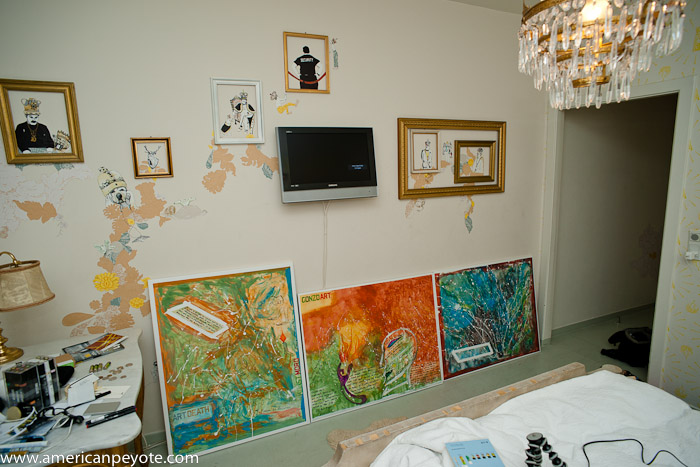
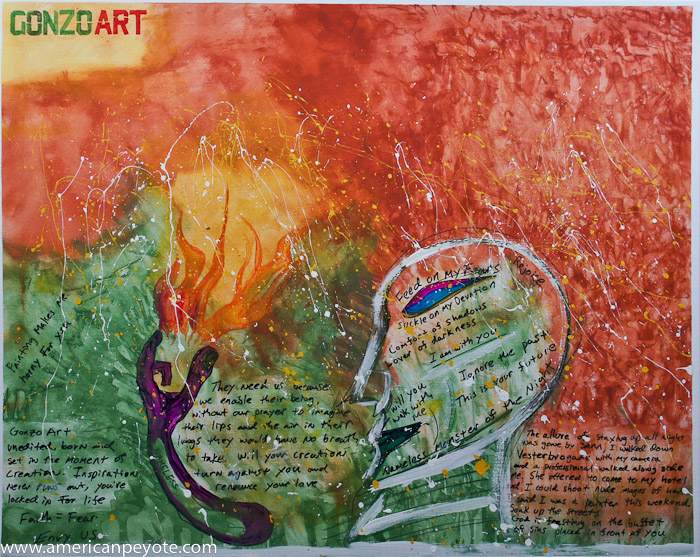
Today is the day I give a presentation on my art at the Rote Fabrik. It’s all part of the professional artist class from the F&F school in Zurich. We’ve focused on writing the artist statement, and today I give a 45 minute presentation of Gonzo Art. There are a number of seemingly unplanned for events which have lead up to the point of me trying to tell the story of my paintings, but for sure I wouldn’t be at this point if I hadn’t won the 1 Day of Art Copenhagen creative invite on Talenthouse. Copenhagen was a stronger marker in my life, and the kind folks from (t)here magazine gave me a creative spring-board to propel myself somewhere I wouldn’t gone otherwise. I like to think I do various forms of art, but this presentation is totally focused on the Gonzo Art concept. It borrows from the Gonzo journalism themes set down by Hunter S. Thompson, I interpret it in art as meaning that the idea goes from the sub-conscious mind of the artist to the world as quickly as possible. No digital, no editing, pure inspiration thrown down on the canvas. Below is my presentation on SlideShare, I’ll add a version with audio but these are the bare-bones of the beast. The final version will include videos showing how my paint lands on the canvas and how the final form of the works evolve (basically like the videos I created for my Lazy Art period). So, I’ve done Lazy Art, this has morphed into Gonzo Art, and for sure it’ll evolve into something else – but here’s the story so far.

Work With Me on a Video Poetry Project

Something went live the other day, a fine determined attempt at creative collaboration on a global scale. It’s called, Collaborate on a Video Poetry Film Series. It’s a creative invite on Talenthouse.com, that fabulous website that connects creators together and is the current website to be on for interesting collaboration opportunities. Essentially I’m looking for a person to work with on a video poetry series. From my side, I’ll provide the visuals and words and you provide the soundtrack. I’ll mix everything together and we’ll ride the wave of internet propaganda to stardom together. On the creative invite page on Talenthouse is the inspiration. There’s a video of my latest still images, and the idea is that DJ’s, producers, etc. can be inspired by that to submit a track that fits to the images. I’ll pick the music submission that best fits in my brain and then we’ll collaborate together on a series of video poetry short films. It doesn’t matter who or where you are in the world, this is an opportunity to connect and work together across cultural, economic, societal and internet boundaries.

Where did the idea for this come from? It was a pretty organic evolution of the internet, inspiration, and motivation. In 2010 I submitted some paintings to a Talenthouse Creative Invite. I won the invite, and then participated at 1 Day of Art Copenhagen with (t)here magazine, then I printed a card of my best painting from Copenhagen and sent it to Jennifer Chalbaud in Venezuela who then had a dream inspired by my Gonzo Art and she created a cool design for Mambo Surf Deluxe. I wrote a blog post about it all and then Talenthouse contacted me, seeing if I would be interested in running a community creative invite. I said hell yes, and here we are.

I like painting because it’s the unknown. I never know what will come when I stare down that big white canvas, and I have no idea what will happen with this creative invite, but soon I’m going to find out. When I create I often think like a movie maker, I hear the music in my ears and break paintings up into little movies in my head. That’s why I’m excited about the possibilities of this opportunity. It’s the possibility of meeting someone motivated to create great music to mix well with the art I’m creating. In this context the idea of video peotry films is just natural for me, it’s the natural evolution of art and video. If you’re a music maker, please check out the creative invite, and you have my deepest gratitude if you pass the word on to anyone you know who might be interested. Click here to visit the page on Talenthouse.com, and below is a video explaining the idea.

and here is the inspiration…

http://www.youtube.com/watch?v=rAHC0rHMRdA

Writing the Artist Statement

It’s about 5:30pm on Wed. so it mush be time for the pre-art class beer by the Rote Fabrik in Zurich. Chilling in the shade, a cool lake breeze on my face – paradise. Time to lighten the head you see, make it all non-linear and stuff, ready to soak up the art direction. Engineering detox, twist the neural pathways into different directions and stretch out the frontal lobe. Time for the professional artist seminar, time to think about an artist statement and professional purpose for the work. I’ve been working on my statement but so far have stalled at, Statement is a purpose and art has none. But that’s why I’m here. If I had it all straight in my head there wouldn’t be a reason for being here drinking a beer, waiting for class to start. Instead I would be sick with confidence and taking the gallery world by storm. Carpe diem and fuck the emotional insecurities, I have something tho say and it just needs to packaged into a conversation that the art can have with anyone.

Ah, yes, the backstory, since I’m depressed enough to be an artist I decided to take a professional artist class at the F&F Schule in Zurich. Olga Stefan is running the course, and each week we hear a mentor from the Swiss art community speak and mentor us on our way to poverty or art stardom. Each week one or two students gives a presentation of their work, and mine is do next week. We’re learning how the art gallery game is played in Zurich and how to go pro. A key element of being a pro is the artist statement. A short but potent set of words that defines and explains your work to the masses. It’s an excellent self-realization adventure to define your work, but naturally the first thing in my head was, statement is a purpose, and art has none. The artist statement is your brand of sorts and should allow any one to get it. However, since the mobile internet thing has re-shaped all manner of print and video media and consumption habits, I’m highly interested in what it’s doing to the gallery scene and art buying in general.

To write a statement I’ve been deconstructing my paintings and their meanings, and the undertone of the meanings behind the meanings to understand my sense of self in order to make a presentation for the class, and eventually, to write my artist statement. I love to write, but it just seems so 1990’s to write up an artist statement instead of creating a video which can be consumed on a mobile device. Maybe I need to unplug? A video sort of thing is in the works, and that’s why I registered ArtistStatement.me the other week. Like with anything, I’ll start with what I know, figure out what I don’t know, and then go from there.

Swiss Startup Camp 2011 Basel – Recollections

The train ride from Basel to Zurich on a Friday night is wonderful place to be. Half the people are calm family types, smiling and say they love each other as they sit down, and the other half are pre-drinking Feldschlossen or some cheap wine, getting ready to live it up at the Zurich clubs all night or a party in Sissach. I’m calm and alone on my computer, recounting an amazing day at the 2011 Swiss Startup Camp in Basel. The day was a blast, a warm, invigorating tech-blast of knowledge and inspiration. It was a high-speed infusion of energy and inspiration, and I hope the momentum will take me places I never imagined.

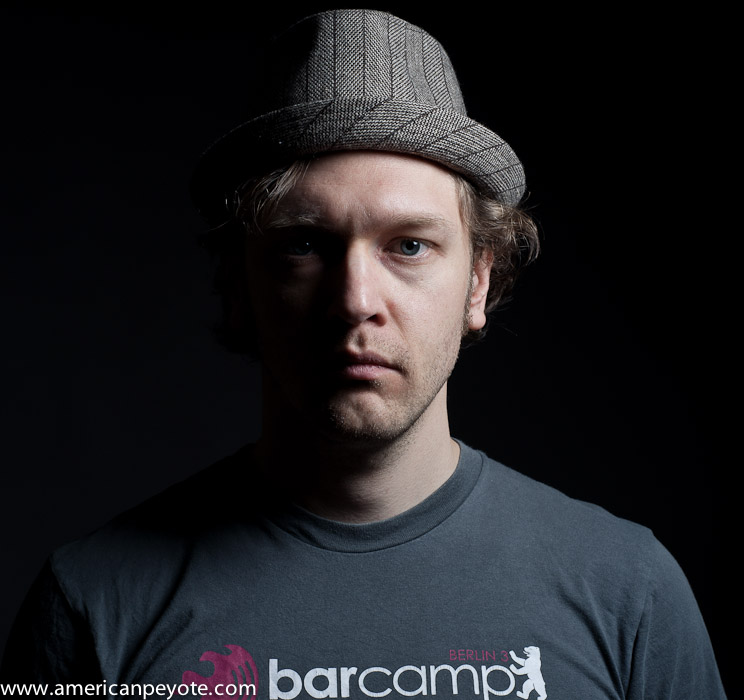
This is a summary of my experiences at the third Swiss Startup camp in Basel, one of the premier gatherings of folks in the Swiss startup scene. You enter not really knowing what to expect, and after picking up your t-shirt and grabbing a coffee we started to discuss who wants to talk about what (the usual barcamp procedure). There are many things which can happen at such an event, but for sure you’ll walk away from the day with a head full of ideas and inspiration to boot. For the past half year I’ve been focused on painting, photography and learning to make movies, and to a certain extent dropped out of the startup events around Zurich. However, I’m ready to get back into it and see what happens. I’ve also been in a sort of tech-soul searching mode for the past half year, and have now focused my energies in three convergent directions: mobile technology, UX/UI, and ebook design. I found my way into sessions about Lean Startup, Scrum, and the Quantified Self.
Lean Startup Factory

The Lean Startup Factory session by Remy and Reto had the biggest impact on me. Lean startup is trending on the Swiss Startup Scene, a take on the Lean Startup Factory from the US. The point is that there’s lots of business ideas every day, week, month, etc. What do we do with them, nothing goddammit, and that needs to change. Forget about sweating the domain name, half desiging a logo, and then failing to execute the idea. What good are good ideas if they never get off the ground? Execution is far more important than inspiration. So fuck the NDAs and business plans, we need to execute, get to the core of beast and start the rock n’ rolla. Well, that was what was going through my head when I listened to Remy (SuperText) and Reto (Doodle) talk about the idea of organizing a Lean Startup Factory weekend in the Zurich area this summer. The main (Fight Club free interpretation) is to dedicate one weekend to breath life in one of your ideas – Build the next twitter in 2 days.

No SWOT, no business research, just team building. 30 people get together on a Friday night, build the teams, and find the core of the idea. Get to the core and execute the idea. No secrets, each team owns the project. No NDAs. Each team owns what they have (because ideas are worthless without execution). The point came up, what about the Swiss startup weekend that already took place. Well, word is that pre-planning and NDAs killed it, because you start to fight between one another instead of creating. Someone said on the street that this will be corrected for this year, but I’m totally inspired by Remy and Reto. Now, who is it for? The startup factory is not limited to developers, but also open to people keen on visual design, interaction design, usability, copywriting, etc. It’s about the whole picture, not just the code. This is the stuff I dream for. During the (t)here Magazine 1 Day of Art in Copenhagen I was exposed to the same method. You go to an inspiring location, dream up ideas on a Friday night, and then create hardcore all of Saturday and show the result. During 1 Day of Art I created paintings I wouldn’t have done in Zurich, and it was all due to the unique energy and inspiration created around the event.

For me, lean factory feels exactly like 1 Day of Art. When I went to 1 Day of Art Copenhagen, it was all hardcore expression and creation. The fine folks from (t)here Magazine put the day together, and I was able to attend thanks to exposure on Talenthouse. However, at the end of the day it was the excellent creative energy and environment of the weekend, cutting out all distractions and just painting with determination in the bathroom of Hotel Fox. It was environment and execution of the idea, trust the process and ride the creative wave and you won’t have to worry about the weekend being a failure – success is the only mother fucking option. The word Factory conjures up the work of Andy Warhol and music from Manchester. You just need to trust in the method and the people. Get people together who want to create, put them in a room with the tools they need, and good things will happen, failure isn’t an option because it’s not part of the equation. The factory plan is like this, everyone meets on Friday, present and talk over ideas, then form some teams and spend the weekend creating, coding, designing, and see what happens. If you’re into this head over to the group, Lean Startup Factory on Amazee.
Lukas Fischer – Lean Startup

I like Lean, and I love reading about management strategies in IT and dreaming of applying them to engineering projects, so after the factory talk I headed over the listen to Lukas Fischer give a rundown on Lean Startup. Lukas heads up netnode.ch, guzuu.com, and spent some time chilling in San Francisco last summer learning and meeting with folks and he wanted to share his thoughts and experiences with Lean. The lean startup trend seems to be trending hard on the Swiss startup landscape, and the room wall filled to capacity to hear what the buzz is about. Lukas started by stated some facts, 70% of startups fail, 10% make money. Why? Because startups often don’t make stuff customers actually want (logical, no?). Lean isn’t a management magic bullet, it’s just a set of best practices to help startups succeed. The concept was set down by @ericries, and @sgblank, considered the fathers of lean startup. First, let’s start at the start. What is a startup? It’s a human institution to deliver a product or service under extreme uncertainty. It could also be an organization used to search for a scalable business model. Lean helps to do that. Here’s my summary of his talk (a bit with my interpretation filled in), but you can also get the slides directly (below here).

So, what is best way to see if there are customers for your idea? Well, you can go through these steps to topics with CUSTOMER DEVELOPMENT:

  • Customer discovery – test hypothesis
  • Customer validation – charge money
  • Customer creation – start sales
  • Scale company – scale it

This sounds all well and good, but what does Lean mean? With Agile development, the point is to do customer development really fast. Speed is key, so use an iteration process (as opposed to Waterfall) when developing your product.

Ideas – Build code – Measure data – Learn – Repeat

Now, the Waterfall model is ok if you already know the solution. However, it is not good for startups because you don’t know the customers, and therefore you are also ignorant of the final solution. So it makes sense to use an interaction process as shown above. So how do you get Lean?

  1. Forget Waterfall
  2. Build up Agile
  3. Build team – focus only on problem team and solution team
  • To reduce the clutter, focus on the Problem and the Solution. The problem team focuses on customers and finding the perfect solution. The solution team builds it as fast as possible
  • Minimum viable product (MVP). When you start with an idea, you need a product which solves a real client problem, but just solves one pain.
  • Eliminate features. Throw out features and resolve a problem for a customer, if it doesn’t solve a problem, remove it from your code.
  • Early evangelists. Feedback of early adopters and people who love your vision is very important, they will tell you early on what features are missing
  • Continuous integration. Iterate, iterate, iterate, deploy your application as fast as possible, measure if the new version is better than old one.
  • Product market fit. A company has “product market fit” when it has found a product that customers really want.
  • Measuring product market fit. Would you be sad if the product no longer exists, if less than 25% are very disappointed, then your product just sucks.
  • Charge. People pay if they can solve a real problem, charge from day 1, it finds out quickly if people are willing to pay for a product or not.

All in all Lukas gave an excellent talk on Lean. For more information you can check out the 5-step startup metric model by @davemclure, and there are internet sites like startuplessonslearned.com. So, my take away messages included, iterate, fix problems, make an error only once, ask why if it happens 5 times, and use lean to stop creating products people don’t want.

Scrum – What is it?

After two sessions of Lean I was looking for something else along those lines, so I headed over to Scrum with Steve Holyer (@zurcherart). Steve is a web worker and a certified scrum master, so he’s a reliable person to talk with on the Scrum subject. What is Scrum? The term originates from Rugby, where a scrum is used to restart the game when the ball has gone out of play. It can also be, an iterative, incremental methodology for project management, often seen in agile software development. What can we use to describe it? Visibility,empowerment, commitments, agility, efficient, hard, easy, fun, self-managing, cool, it works, best practices, hyper-productive. I’m totally new to Scrum but, from Steve I got the basics. There are some main team roles: Product owner, Team, Scrum master.

Product owner: Knows the customer, decides where the team should go, but not how they get there or how fast, owns the product backlog, prioritizes the product backlog (but does not estimate the stories in the backlog). Usually not the line manager.

Team: 5-9 people, doing the work to complete the project or sprint, self organizing, the team want to get it done and it’s up to the team to get it done, cross-functional, attend the daily scrum, not limited to coders and developers but also analysts, testers, etc. Can also include scrum master.

Scrum master: Coaches everyone in the process and scrum practices, removes impediments, holds the daily scrum, usually not part of the team, usually not the line manager, usually not the tech guru, protects the team. Leads most of the meetings.

Then we move into activities, what is the scrum, how does everything work? We start out with activities. Activities are basically just meetings, but very well defined meetings, which follow the same format in a limited time and are well structured. These include sprint planning, daily scrum, and review. The first two are the less-obvious for me. Sprint Planning: Product owner presents the backlog, the team is there to question the product owner, re-estimate, re-prioritize, estimate velocity, select stories for the sprint. Part two starts after lunch. Break down tasks, at the end the team commits to delivering so and so stories at the end of the sprint. Daily Scrum: This is the sprint commitment, the team has committed to deliver this to you, if you add new tasks in the middle of the sprint, you’re asking them to do something that breaks their commitment. Do you really want to do that? If yes then stop the sprint and replan.

As a mechanical engineer who is always working in Waterfall, it was very interesting to hear Steve talk about Scrum. Some of these techniques are being brought over into the mechanical world, where it has been called Concurrent Engineering. However, I would rather go to the source, and I like the terms Agile and Scrum a lot more. I’ll see how I can integrate the Lean and Scrum management and development ideas into my future projects. There are many parallels in the mechanical engineering world, especially now as more and more projects rely on simulations and virtual prototyping in the development process, but change doesn’t always come easily. Still, I’m optimistic for the future.

The Quantified Self

My last session of the camp was about a website called Quantter (Quan#er) and the Quantified self by Denis Harscoat (@harscoat). Do you know what that means? I had no clue, but it’s the future, and this is how it has begun. The quantified human was the most experimental session I attended. I say experimental mainly because the movement is still so new that even a wikipedia entry didn’t come up when I googled for it before the talk. Quantified Self refers to humans who have quantified themselves, it means people who gather, digest, and interpret data about themselves. Their heart rate throughout the day, their brain waves and sleep patterns, how much they walk each day, what they eat, all these things can be easily measured and recorded now using basic sensors or an iPhone app. This will be big for various reasons. On one hand, we all know that people love to collect and analyze data, and if they can do it about themselves and then share it, it opens up a big market for people to compare their data with that of other people. It’s also an avenue for medical research, and helping people gauge their own healing process and for doctors to monitor patient stats in realtime. The idea is really very powerful. It is the idea of knowing yourself in numbers. It means development of tools for quantifying parts of your life, and using technology to understand how to live in a better way. Once you have and can see the data, the next question is how to interpret it, and then to take action on what you’ve found out about yourself. The website Quantter (Quan#er) is a platform for people to share tweets and things about the stuff they’ve quantified. I can see this as being a big, actually potentially huge growth area in the future if it takes off. For it to take off there needs to be mobile applications to easily record relevant information that can be quantified, and I think that’s where the money will be made. For more info on the quantified self, check out Quantifiedself.com to get info on what people are doing with it and meetups. There’s also a video of Denis of a meetup in Amsterdam on vimeo.

The End: Moment of Zen

Thank you to all the organizers and sponsors, this third Swiss startup camp was fantastically awesome. The startup camp is a wonderful platform for startup folks around Switzerland to meet and develop new opportunities and ideas. It’s consistently the best barcamp I attend every year (yes, it beats out Berlin) and I left Basel with some serious motivations and ideas. Now it’s time to go to work. But first, your Moment of Zen, here’s my favorite random quote from the day (picked up at the after-party):

9 women working one month can’t create a baby.


Bratz War Images

On my last trip back to Detroit I marched with the Nain Rouge, and then had a little buying madness toy-spree at Toys R Us. I also picked up a Cleo de Nile doll at Meijer one night after playing trivia at a bar during some low-level Thundersnow. Anyways, I then raided the toy chest that is the basement at my parent’s place and put together some small war sets with the various objects/subjects/toys. I took what I had to work with, that included a super old Estes model rocket, some plastic army soldiers, a landscape, a .50 cal sniper rifle from a G.I.Joe, some tanks, and, I guess that was about it. This is sort of an ongoing project. Every time I head back to Michigan I find another collection of toys to use, I setup a small stage, do some shot arrangements, and then bring the images back to Switzerland for post-processing in Photoshop. In these images I’ve added a lot of overlays from Rome, Zurich, Tokyo, and Detroit. Images of concrete and walls were added as well to texture the images, and the odd-sun flare is thrown in as well when needed. I’ve since picked up a copy of Strata Foto 3D, and am investigating the possibility of creating 3D models of the Bratz, Cleo de Nile, and various toys, and doing the images or a short movie all in the computer, but I need to learn me some 3D skillz first.

Anyways…enjoy…Bratz War

Detroit Fasnacht – La Marche du Le Nain Rouge

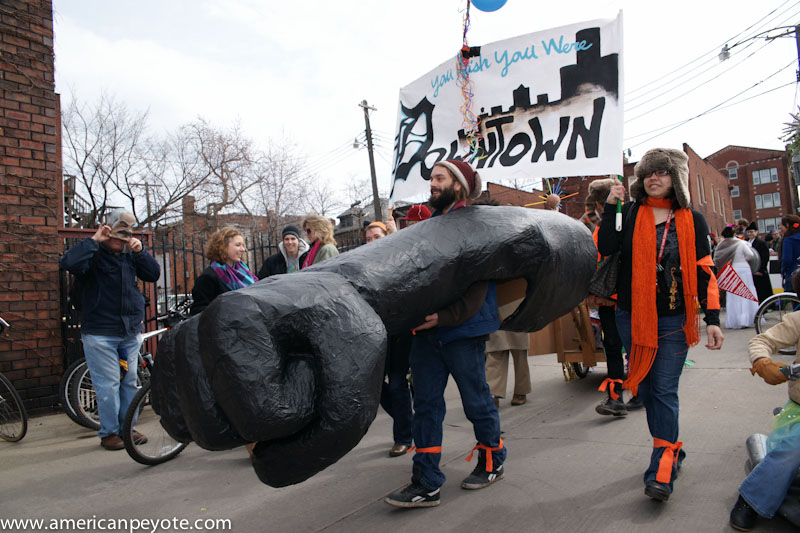
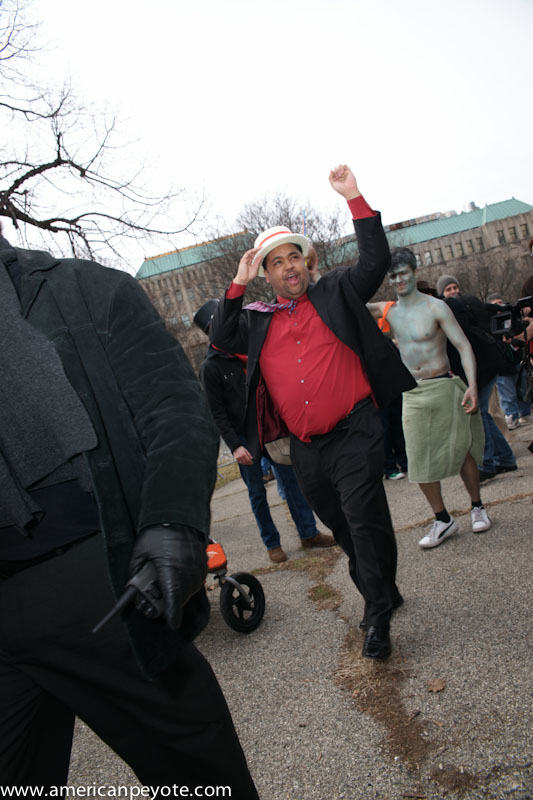
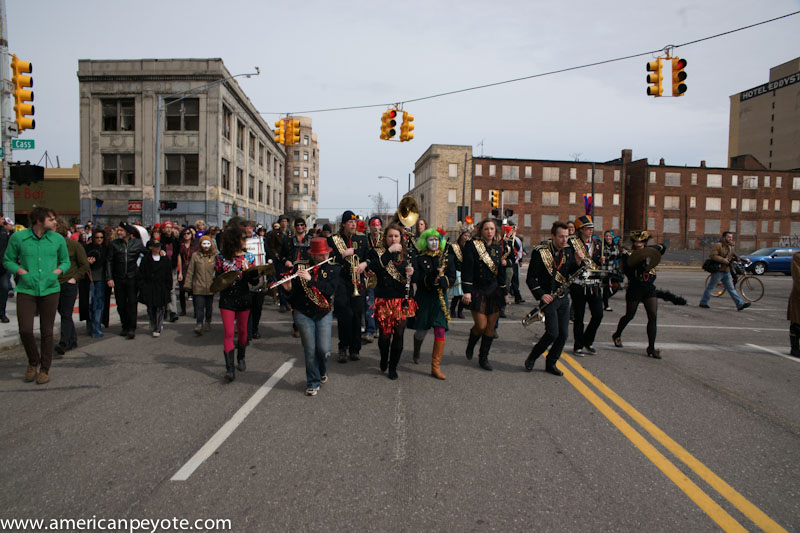
An interesting holiday has been resurrected in Detroit called Marche du Nain Rouge. It has some historical roots in the French-influenced history of the city. Apparently (I know someone who actually talked to a woman who saw it one night) there’s a devil (or dwarf if you like) living in Detroit, and has been there for some time. On March 20th the good people of the city gathered together and marched down the street dressed in red to scare the devil from the city. I imagine that the devil then scampered over to Dearborn and there was a party at Shatilla to toss the Jinn out of Dearborn. Then for sure it went to seek refuge in Sterling Heights to deal with little old Polish ladies who tried to bash his head in with rolling pins. Anyways, it’s a reason for a party and from the timing has some parallels to the Carnival season and the Fasnacht festivals in the German areas of Europe. With that in mind, my girlfriend offered to help design and make with me a fine red devil mask for me to wear on my vacation to Detroit this year. I’ll arrived too late for St. Patrick’s day, but just in time for La Marche du le Nain Rouge.

The Mask

For the mask we decided to make a classic Fasnacht mask from plaster. The basic idea is to lay strips of plaster on your face and let it dry and then take that mold of your face and create the mask. This ensures that the devil will see your eyes, but not recognize you, making it impossible to take revenge on you later in the year. To make sure the mask doesn’t stick too much to your skin it’s good to apply a cream to your face before starting. So I closed my eyes and my girlfriend started spreading coconut fat on my face, and I burst into a laughing fit of a solid 10 minutes. Eventually I settled down and sort of fell asleep while she layered my face with wet plaster strips. In the end I spray painted the skin of the beast and let it dry for March 20th. As Fasnacht gear was being sold all over the Zurich area I picked up a sort of strange devil pagan skull on fine black stick to carry around the Cass Corridor. Sadly I had too much chocolate in my luggage and had to leave it in Switzerland. I imagine it will find an essential use at some point in my life, maybe for the next march.

I am the Despair of Detroit

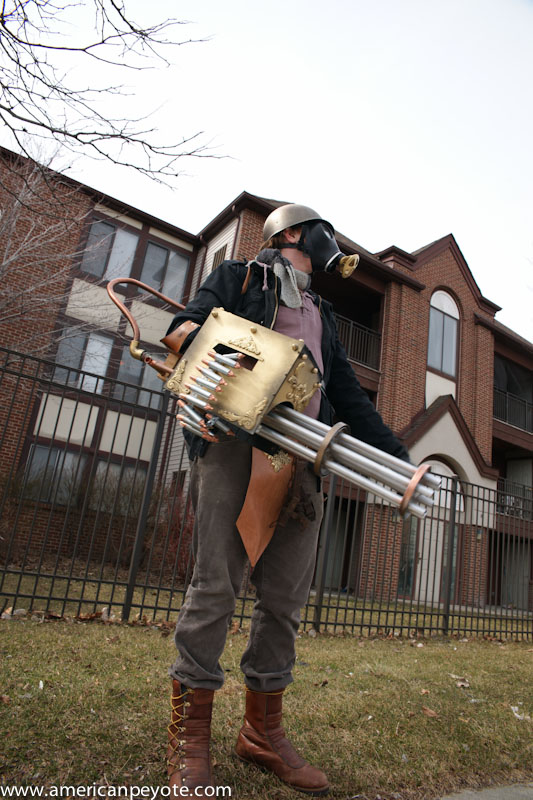
Everyone met at the 3rd Street bar around 1:30pm, and then the Nain Rouge appeared on the rooftop. He had a viel red face with sharp teeth and a devilish smile. From the shadows he took responsibility for moving the Pistons to Auburn Hills and stated that he is the despair of the city, a beacon of depression to steal the hope and quash the dreams of anyone standing within the city boarders. Merde de Tete Monsoir! From there a decision was made to march the Nain out of Detroit, and ah, he complied and everyone headed down the Cass Corridor to Case Park where a Cadillac drove up and Coleman Young walked up with the Spirit of Detroit and took the Nain away. The Nain was outstanding, but took a backseat to all the excellent people I met and checked out on the street. The Detroit Marching Band played excellent beats and I happened upon such characters as a Steampunk dude with a mini-gun for an arm and iron fist of Joe Louis. However, at some level I feel like I’m on the wrong side of the conflict. The Nain Rouge was in the area before Detroit was settled (read it on Wikipedia), so in reality the Nain is just defending it’s land, is this the message we want to communicate to the world, that it’s ok to kick the Nain out of Detroit, or Nainland? Shouldn’t we all try to get along? The Nain is possibly a quite upstanding fellow, who simply wishes to enjoy a Cuban cigar on the banks of the river while watching the sun set? I’m looking forward to flying into D-town next year with a new mask.

I’m Not Depressed, I’m An Artist

I’m not depressed, I’m an artist. Remember this, for it is my new motto with which to deal with certain aspects of life. In a book I once wrote, “Now, actually being an alcoholic is an unhealthy way to live, but pretending to be one for the night helps break life up into more manageable chunks.” If you pretend to not be an artist, I don’t think anything good will come of it. If you wake up wondering why you feel depressed and unfulfilled in the morning, it’s possible that you’re simply an artist. This one simple realization can make a large difference in your day to day life.

Accept who you are and always look on the bright side. Pretending to not be an artist will probably make you depressed, but actually being an artist opens up a whole city of plausible excuses and diversions to sensible responsibility. For example, when you’re an artist you can say, “I can’t do math today, my brain patterns are too nonlinear.” This is a no-go statement in the engineering world, you have to do math because that’s how we understand the natural world. “I can’t work today, I’m in a creative void, I’ll stay at the cafe all day drinking espresso.” To be fair, I don’t think this is reality, it’s just what I’ve see from the movies and over-dramatic artistic characters. I imagine myself more like a poor Howard Hughes, who wasn’t an artist in the traditional sense, but had the fantastic ability to run an engineering empire and be a director of photography in the same lifetime. Or maybe like a Paul Verhoeven, who holds degrees in math and physics, but also directed Starship Troopers and Total Recall.

For the longest time I thought I was an engineer who just liked to draw in math class.  I figured it would stop at some point and I’d just use these talents to design car handles or airplane designs or something.  Now I’ve realized that I got it all wrong these first 33 years, and my birthday is just after Marche du Nain Rouge, so there must be some Detroit devil inside me, and I think it’s time to admit defeat and start dealing with being an artist. Understand, I don’t really know what it means to be an artist, I only know the engineer lifestyle. I never attended art school and haven’t a clue how to act or conduct myself. I already wear colorful shoes and carry pens around to write and draw with. There’s a room in my apartment dedicated to painting and I have a pair of jeans stained with colored latex. What else should I be doing?

I don’t have a specific medium that I work in. I was asked once what texture I use when painting – and my first impulse was to ask the woman what the fuck she was talking about. As I understand it, texture is what the surface of your painting looks like (I thought it was just a layering technique in Photoshop). Always a new language to learn. I like to think that I specialize in ideas, and they come out in painting, video, digital photography,  whatever is at hand. The biggest problem is the need for expression, and this is the friction point with traditional engineering persona. Here is where the friction of the situation leads to conflict in the brain. For some personalities it’s easy, or at least normal to just calculate things and to find solutions in a number format and to be done with it. It would be nice if that were enough, but it’s not. I want to hold a thing in my hand. I like to bring something from nothingness into being, from concept to final product. It’s scary to stare down a blank white canvas and it’s a rush to look upon the final work. When you get used to feeling that rush in the studio, you naturally want to feel it elsewhere, it becomes a normal entity in your emotional map. However, it’s difficult to attain in a traditional engineering world. The only sane solution is to find a happy medium. Something which includes design and science, something where the two sides can coexist and benefit one another. I don’t know what the future brings, but hopefully I’ll find out soon enough.

Talenthouse – Inspiration Around the Globe

I live in Switzerland, and here is a picture of Jennifer Chalbaud in Venezuela, holding a picture of my Gonzo Art painting. The internet is a fine and fabulous thing, but I grew up writing things with a pen, and that’s sometimes the best way to send a message. This isn’t always the case, my hand-writing can be horrible and near impossible to read. However, if I take my time the writing is coherent. Sometimes I’ll write a letter on the computer and then write it out by hand to send. In the instant message update world of Facebook and Twitter, I think it’s important to write by hand sometimes. Just like I think it’s important to sometimes paint with real brushes instead of only with the virtual ones in Photoshop. Words are sometimes more meaningful when you know that someone took the time to write them specifically just for you. Sharing words on Facebook and Twitter is fine, it’s fun to do and sometimes contributes to the over-throw of governments. Sharing written words is a dying form of communication, but it’s far more likely that you’ll be able to read a written letter you’ve saved in twenty years than find the random Tweets you’ve sent.

The Background

Sometime in the past I joined a website called Talenthouse.com and added some paintings to my portfolio. This was all fine and good, but then I applied to a Creative Invite competition, I won, and as a result spent a weekend in Copenhagen as a guest at Hotel Fox, doing paintings for (t)here magazine. This was an interesting time, but one of the cooler points of a place like Talenthouse, is that you meet interesting people you wouldn’t have met in any other way. One such person is Jennifer Chalbaud,  a fashion designer from Venezuela. Around Christmas time in 2010 I decided I needed to stop just using Facebook and Twitter to send messages and decided to step back in time and write some cards or letters. To be dramatic, I told people I was protesting the instant update. I decided it would be best to get some of my photos/paintings printed, so I got cards made at moo.com, my favorite place for such things. I had five images printed, including a Bratz doll, an image from my ProtestLove series, and Gonzo Art (my masterpiece to date), produced in Copenhagen. I figured it would be best to send cards to people who want them, and I posted an update to Facebook/Twitter asking if anyone wanted me to send them a card. One of those who responded was Jennifer. She said she liked my Gonzo Art image so naturally I sent her one of those. In the card I basically said that it’s been cool getting to know about her and her work, and that it’s great to get to know people who you feel inspired by.

Sharing is Good

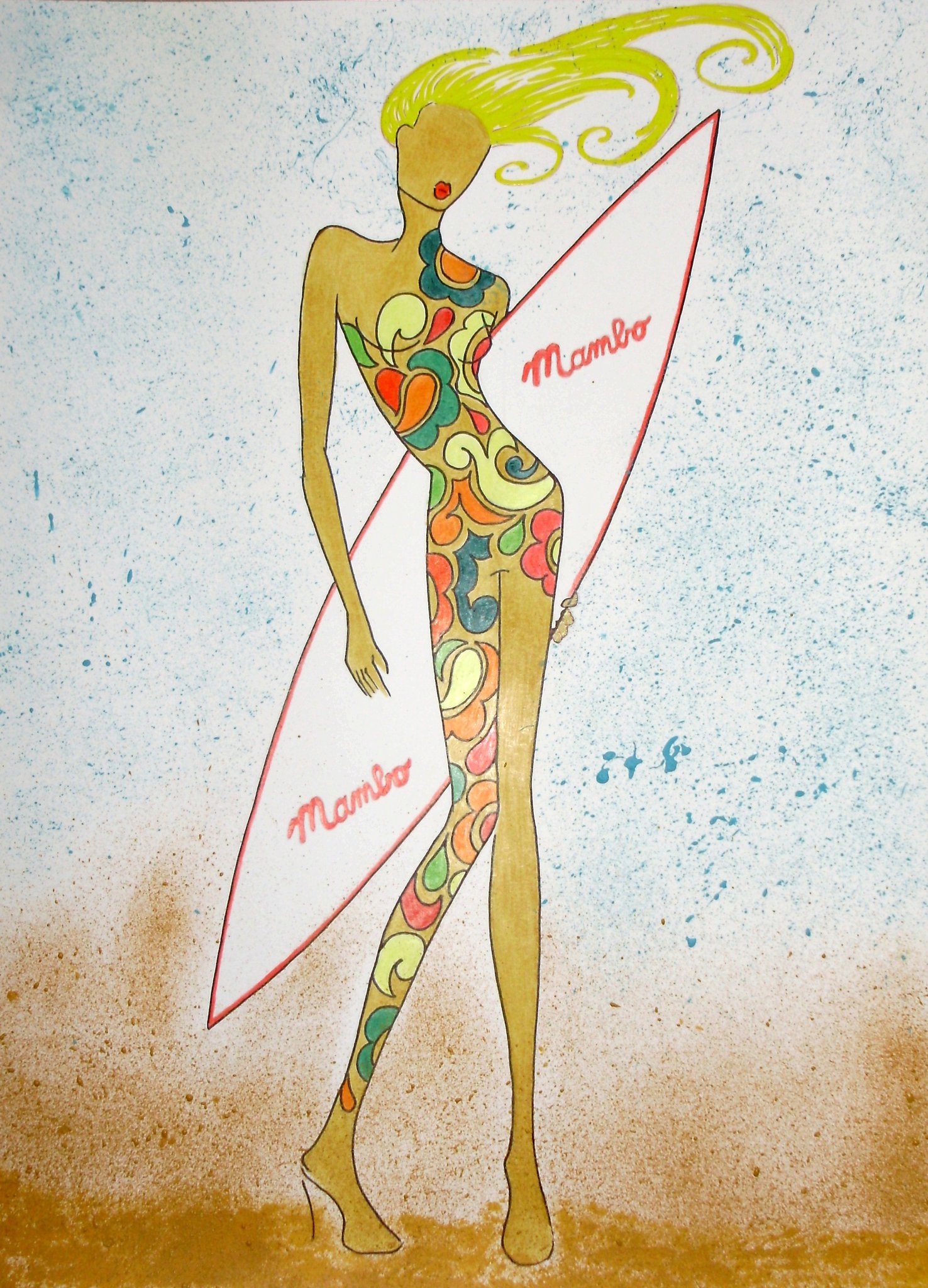
Eventually the Gonzo Art card worked its way through the global mail systems and ended up in her mailbox. Then Jennifer had a dream (this is how she described it). In her dream I was at a beach taking some portraits of a couple, and the couple had done some body paintings done in the style of my Gonzo Art. The idea for Gonzo Art was taken by me from from the writing style of the late Hunter S. Thompson, the idea being that the work is done fast and with a purpose. It should happen in the moment – without thinking, the hand writes what the mind perceives and it’s sent off to the printed without edits (of course, this never happened in reality).  So, Jennifer followed that style for her inspiration and created a design for the Mambo Surfdeluxe contest on Facebook.

I’m a trained scientist and I naturally like to look for patterns in life. Patterns give people a certain reassurance, a slight feeling of being able to sort of tell the future by understanding the rules of the World and the rhythms that operate in the universe. Other people prefer total chaos. One of the surest patterns I know in this life is that sharing leads to good things. It worked when I was five and it works even better now. I shared my art on Talenthouse and had an awesome experience painting in Copenhagen. I shared some thoughts with Jennifer and sent her an image of my art and she was inspired to create something new of her own. She has shared this creation on the Mambo Surfdeluxe Facebook page, and it has been viewed by a number of different people, and I wonder what they have been inspired to do. Be inspired, create, share, repeat.

Check out more of Jennifer Chalbaud on Talenthouse, Facebook, and Twitter (@jennychalbaud)


Ethan Oelman – Dancing with Water Video

I first met Ethan at the Strobist CERN workshop a couple years ago. Since then we’ve both grown our photographic styles and meet up for a coffee in Zurich to bounce ideas off one another from time to time. I’ve been getting into video and short film production, and Ethan was interested in doing a video project on his work. So it was a natural thing to make a video together about his photography. The goal was to do a behind-the-scenes video during a shoot, and then bring that together with the story behind the images. After the Dancing with Water shoot, I dropped by his apartment and filmed him talking about his work and the images from the shoot. During the shoot I also shot some footage of one of the dancers, Alexa, coming in and out of the water and put together a shot film called Birth-Kraft. Basically I just took everything I learned from watching Vincent Laforet on his CreativeLive film workshop, and produced this short video of Ethan Oelman and his photographic vision.

I had a wonderful time producing and shooting this video. I was getting intimidated a bit watching the CreativeLive workshop, but once you break things down to the essentials and put together the essentials of what you need for your project, all you need is to focus on your vision and forget about the rest. To see more of Ethan’s work, check out his website, Ethan Oelman Photography.

Tech Details

For those who are interested, the footage was shot with my Sony NEX-VG10, using a couple of different lenses including a Mamiya 645 80mm f/2.8 both on a tripod and using the Jag35 Field Runner rig. I used a Manfrotto 501 fluid head when on a tripod. The audio was recorded using an old Zoom H4 and was synced to the original footage using the Dual Eyes software. Everything was cut together in Final Cut. I’m looking forward to picking up a lapel microphone and also a shotgun mic to improve my audio gathering capabilities on future projects. The music is from Moby Gratis.

ArtDeath – KunstMord Short Film

Photography is a fun hobby, but it’s been taking a side-seat to short film and video production. My first coherent attempt is called ArtDeath – KunstMord. It’s a bit of a self-reflection piece, centered on the idea that the artists is driven to destroy their work, and in doing so set their spirit free to create again. I don’t know where this came from, but it’s a theme I’ve been building in my brains, and 1 Day of Art Copenhagen put things into context for me. I’m a lover a visual media, and it seems totally natural to present a painting as a concept in a short film instead of just in a gallery. The painting is just a container for the ideas and feelings of the viewer and of the artist. Film gives the artist another pallet to work with in displaying the work. Essentially I want to take the content of paintings, including the background story of how the work was created, and package that together into short films. At the point the term video poetry comes to mind, and I see short films in my head which are a mix a visuals, poetry vocals, and the correct imagery. Of course, implementing this is naturally had to do until you know what you’re doing. My first attempt was Gonzo Art – I: a short film all about my Gonzo Art painting with vocals connected to the writing I added to the painting.

Production

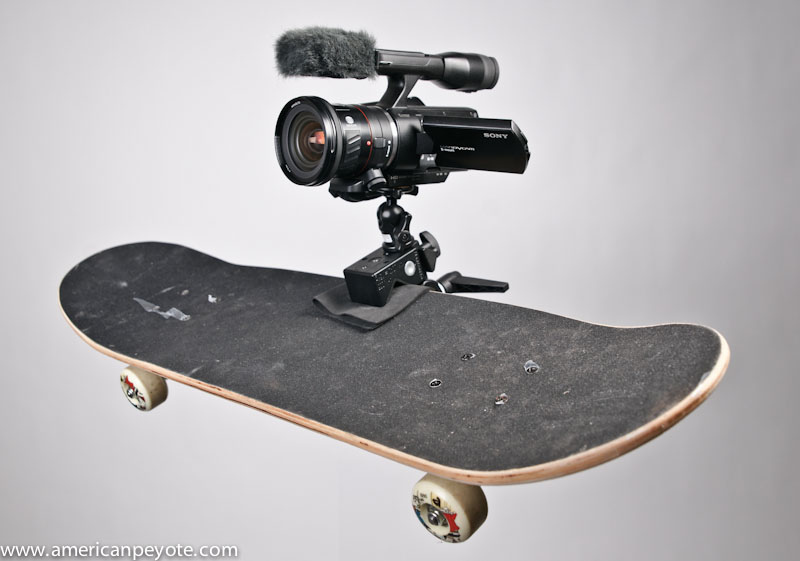
I had had the idea for ArtMord (or KunstDeath) for a while but time was short, so I shot the film with my girlfriend over a few nights time and used such innovative production equipment as a skateboard dolly with my NEX-VG10 attached with a Manfrotto super clamp. This had the nice effect of not being totally stable while rolling on my hardwood floors, and added a nice vibration to the footage, which fit in nicely with the tension I wanted to build in the film. Naturally it’s up to the viewer to decide if this worked or not.

I added my Big Blue Beast chainsaw to the mix, as I like the idea of mass and loud destruction on an artistic scale. I don’t think the machine actually works, but it was irrelevant as I used music to simulate the beast getting fired up. In the future I envision a flamethrower, but I’ll need a real place to work in, like an actual industrial space or studio instead of my apartment. For the soundtrack I used GarageBand with my own vocals, modified of course, to sound like high-pitched youth. It somehow mixes better with the back-beats than my natural voice (or so I thought at the time). It’s like when I do portraits and I want to add a texture layer, somehow it just makes everything mix better together, like baking a cake or cooking an Indian curry for dinner.

ArtDeath-KunstMord Film

Review: Scott & Neil’s Designing Web Interfaces Master Class

Scott & Neil’s Designing Web Interfaces Master Class
The Designing Web Interfaces Master Class by Bill Scott and Theresa Neil is, well, a class about designing web interfaces, discussing the common interaction design elements of successful web pages, and also those dreaded annoying/confusing design elements that designers sometimes use. Watching the class has put a lot of these design elements into perspective for me, and given me a much better grasp of the big picture of interaction design and program interfaces. Overall, the Master Class is worth a look. I’m at a point where I’m interested in learning and absorbing a lot of information about user experience and interaction design, so this is a nice overview of the entire concept of user interface.

When you have these types of talks, it’s important for structure to exist. The class is presented as a class, meaning a lecture format. This is ok, but I think for a video it’s much better when you have more involvement from the class. With this human interaction during the video, the viewer will become more immersed in the topic. You have a pdf copy of the class, which allows you to quickly go through the content, refresh your memory on what was said, it’s nice complement to have with the video.

What I Took Away

The Master Class gives you a technical and philosophical overview of user interface and interaction design. It’s not to show you how to code interfaces, but from a global design perspective, what user interactions exist on different web pages, what works, what’s confusing and difficult for users, etc. This is for people who are designing programs or web apps and want to understand what elements of user interaction are good for the user and what should be avoided for your project. I can imagine coming back to this video over the next year to rewatch certain parts like I do with the Vincent Laforet CreativeLive HDSLR workshop. Now that I know about camera sliders and the basics of getting a move production together I have a whole new appreciation for film, and due to the Master Class, also for interaction design.

Some of the main points I took away are that user interaction means patterns, and anti-patterns, what works within the context of a design interaction problem and what has been used and what works and what doesn’t. So, you can expect to know and understand how to apply different user interaction design principles to solve user interaction problems. Once you get through the video you’ll start to look at webpages with an eye to user interaction design (incase you hadn’t before). You’ll likely start to get pissed off at poor design and prais elegant interaction design on webpages and software you use. You’ll see the user interaction concept from a global perspective.

In Summary

The video is for sure more philosophical and conceptual than practical. If you want to know how to code this or that slider interaction in PHP or iOS, this isn’t the video you’re looking for, that’s another subject. That’s how to implement the design, this video is focused on developing a strategy, and it’s important to mention that it doesn’t matter how well you can code something if you don’t have a strategy for creating a useful product for you users. Many user interaction problems are not new, and it’s important to see what problems have been solved. It’s about removing barriers to common workflows.

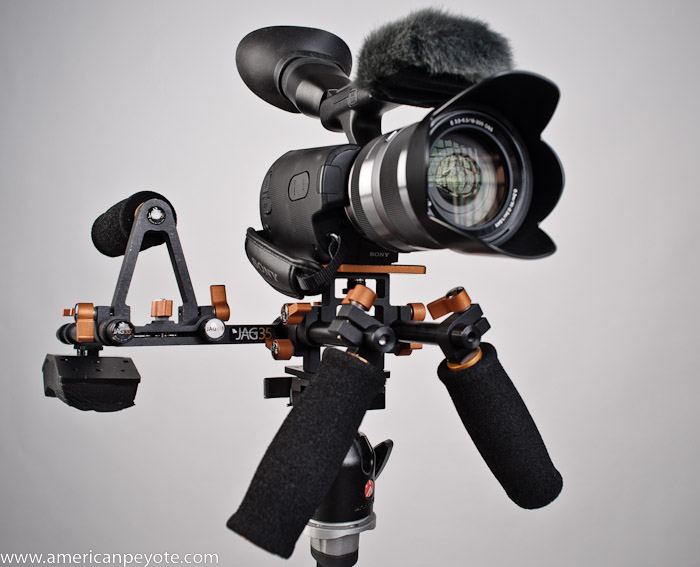
VG10: Jag35 Field Runner Rig Review

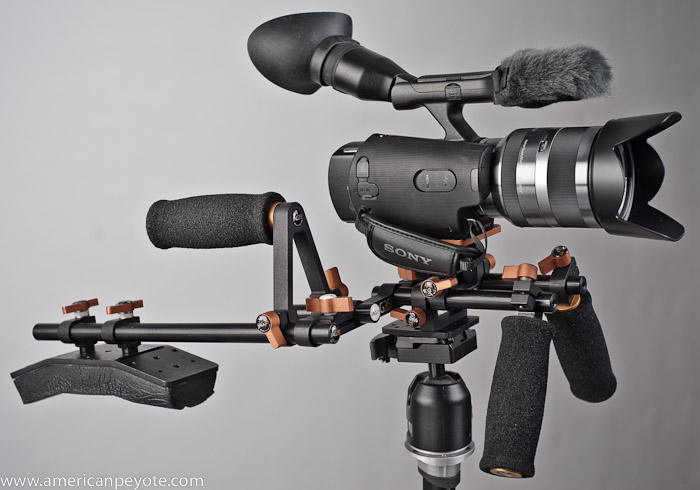
I picked up the Sony NEX-VG10 because it has more of an all-inclusive video camera design than going the DSLR route (Canon 7D, 60D, 550D, etc.). However, as I started using the camera I decided that a shoulder rig would add a lot of functionality to the system to stabilize the camera and to shoot in different situations (and I’ll admit so some gear lust driving my purchase decision). I opted for the Jag35 system because they offer rigs at affordable prices for people in my buying group: folks who are getting into Indy film production but don’t have a huge budget. I decided on the Field Runner because it’s under 300 USD and came with a free handle when I ordered it. I also picked up a tripod baseplate to quickly go from tripod to shoulder mount on shoots.

Shooting with the Field Runner

The Field Runner is fun to shoot with, and that’s an important point. I use the Field Runner with the NEX 18-200mm autofocus lens or something wide like the Sigma 20mm f/1.8 or a Minolta 20mm f/2.8 and stay mobile. Since the NEX is autofocus I don’t yet worry about pulling focus and haven’t added a focus follow to my camera kit just yet. With the 20mm lenses I set the aperture and manual focus as desired. I can then shoot with the rig on my shoulder, or down low from my hip. I’m currently using the Field Runner without any counter weight on the back since the VG10 is pretty light the counter weight isn’t such an issue, but I’ll probably add one in the future to stabilize the system.

On the shoulder the VG10 is very nicely stabilized, and is much better than shooting in the classic Handycam method of just holding the camera in your right hand and putting it up to your face like a tourist or last-rate pornographer. With the Field Runner the VG10 becomes a part of my body. It moves with me, rotates with my torso and feels connected to my center of gravity. In short, it does exactly what I was hoping for when I ordered it. The VG10 now sort of feels naked without the rig. I can imagine shooting without it, but don’t see the point. It’s also nice to cradle the rig in my right arm and hold it to my body, with my left hand on the front handle. I also often shoot from my hip. To do this I make the front handle parallel to the rig and hold that handle with my left hand while holding the raised handle with my right hand and then rest the shoulder pad on my hip and then pan with my body. This is a very secure was to do a low pan when needed and is very comfortable.

Mobility

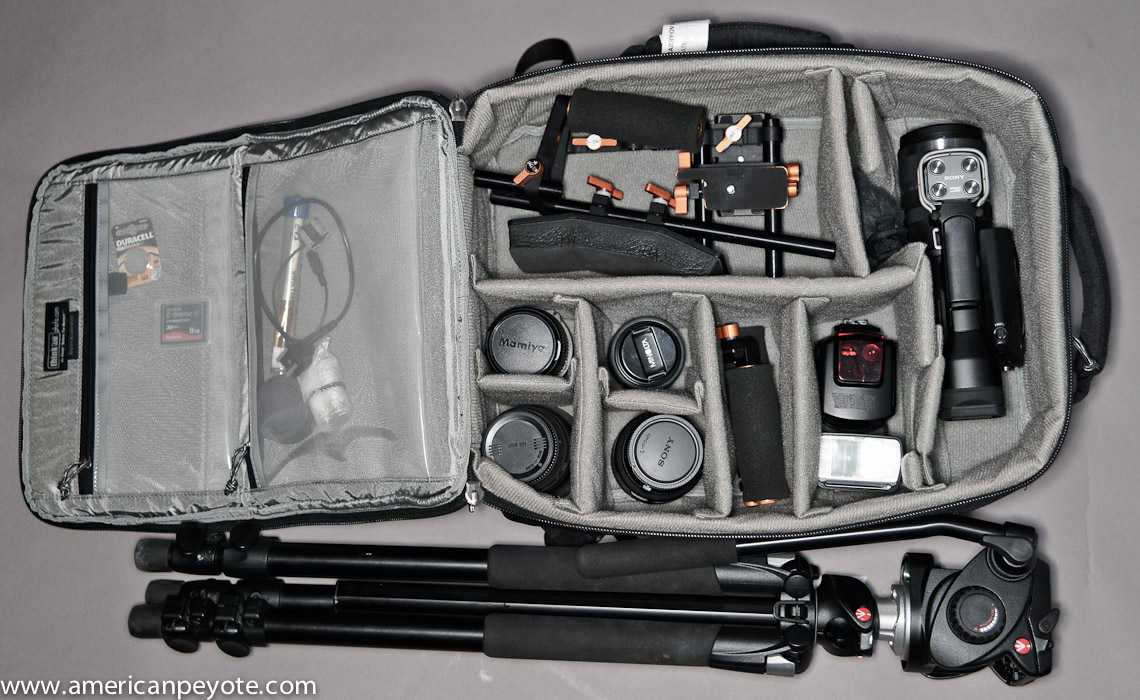
I like to be mobile as a film maker or photographer (or painter for that matter). I like gear that easily moves me and packs up quickly. I can easily pack up the Field Runner with my VG10 and an assortment of lenses into my Think Tank Airport Acceleration and go without any issues. When on location the Field Runner assembles in a few seconds and I’m ready to shoot. With the optional tripod plate I can mount the rigged camera on my Manfrotto 501HDV fluid head and quickly switch from tripod to hand-held in mere seconds. I just need to swing out the front handles to allow the rig to slide onto the 501 head, but since the handles are locked down with simple twist knobs, this is very easy to do. Then when I go from tripod to shoulder it just takes a second to swing the handle back into position and lock it down and I’m ready to shoot again.

Design Issues

These are a few design issues I’d like to address that may be serious or totally irrelevant to potential buyers. Overall the Jag35 Field Runner is a good value for the money, but there are some areas of the design that need improvement in my opinion. The most serious is related more to the VG10 design than the rig, which is likely irrelevant with any another than the VG10, but needs to be mentioned. The connection of the VG10 tripod plate to the rig is very insecure, this is the heart of the rig system and should be the most well-designed and quality-controlled part. However, this is a design issue with the VG10, and not the Jag35. Now, this is has to have some context. The Field Runner is designed for a DSLR body, and I’m using it with my VG10, which has a long base like most camcorders do, while DSLR bodies are short and wide. For the VG10 you should have a long attachment area like a Manfrotto video plate, which produces a nice secure contact area on the bottom of the camera. This connection system is offered from IndySystem or Cinevate, where you can screw a long Manfrotto plate onto your camera and then just lock that into the baseplate on the rig.

To compare, I also tried the Jag35 camera plate with my Sony A900 just to see how secure it would be with a DSLR body, and it was totally different from the VG10. With a DSLR body the camera sits securely to the Jag35 base plate. With the VG10 it’s ok for basic shooting, but I don’t have faith in the attachment to my camera to forget about it, and is a primary reason I’m looking at adding an IndySystem camera plate to improve my rig setup. I also think the current design would be greatly improved by using a metal knob (similar to those on the rest of the rig) instead of plastic covered screw on the camera plate, as it would be easier to securely tighten the camera plate to the camera tripod socket.

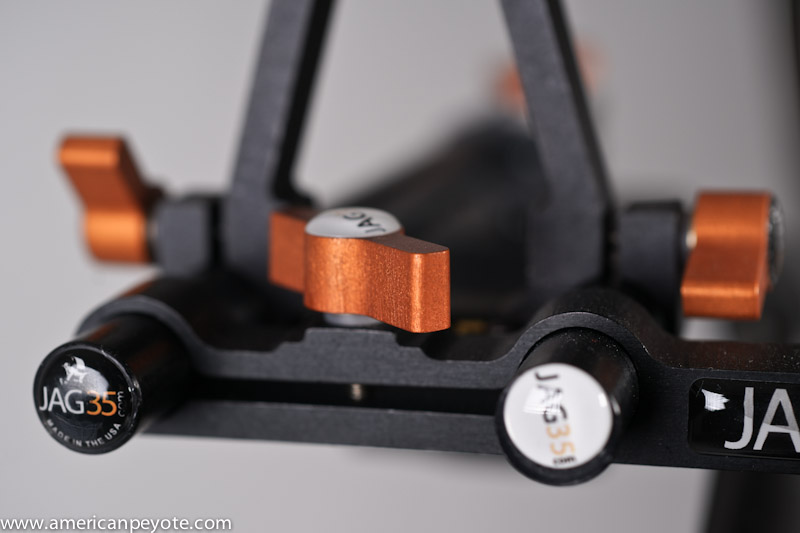
I also found some minor misalignment issues with the connectors which hold the rods together, but this is a smaller issue and doesn’t affect the performance of the system. When the screws are tightened the rig is rigid and secure, and that is the function of the design that matters most. The optional handle could also be improved. The handle needs a lock-off screw to prevent it from rotating. As it is, the off-center handle can easily torque due to the weight of my camera and twist open when held, which is a basic design fix that should be addressed. For this reason, I always need to hold the rig by two hands to prevent unscrewing and rotation. For a rig of this price point and production volume, these design issues are more or less acceptable, and I’m confident they will be ironed out on future rig releases.

Design Update

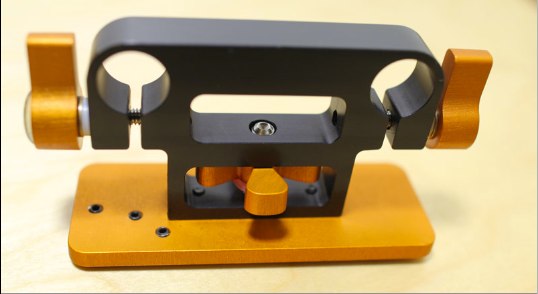
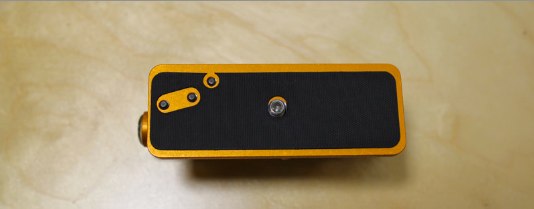
Jehu Garcia, one of the people behind Jag35 pointed me to an updated design for the camera mounting plate to address the issue of camera-rig connection. There are two key and very welcome design improvements. First, there are a few screws in the base plate which can be screwed to contact with the bottom of the mounted camera. This then counters the tendency of the camera to loosen from the mounting plate. This addresses the torque loading on the rig-camera connection, which can occur when a follow focus is used. It can happen that reaction forces develop at the rig connection point, and these screws help resist those loads by counteracting the torque. From the design, it looks like the new plate will also improve the issue with the VG10 (and the poorly designed Sony tripod mount). The second modification is a nice big aluminum knob. This will make it much easier to tighten the rig to the tripod socket.

Overall I Like It

I’m a mechanical engineer by profession and a scientist by training, so you would expect I’d find and write about any mechanical design issues that I find with the gear I use. However, I can honestly recommend the Jag35 Field Runner, for the price it’s a great rig for new Indyfilm folks and those on a budget. It will be used by weekend warrior film makers and those who don’t mind a few design short-comings. The price difference between the Jag35 offerings and a similar rig from one of the pro-shops like Zacuto or Redrock Micro is nothing short of amazing, and I’m impressed that they have grown so fast and come so far in the short time Jag35 has been selling gear. They’re releasing a motorized follow focus, and they’re even making it wireless. The innovation and price point of their gear is really impressive. At one point I actually was going to start designing my own rig system and get some custom prototypes made, but once I saw what is coming out of Jag35, Habbycam, and IndySystems, I decided the market doesn’t need another rig maker in this category. Of course, the rig system in my head will be designed to be ultra-light using carbon fiber rods with a structural design optimized using Altair Optistruct, so it’s still possible I’ll do something in the future if I’m motivated enough. However, I’m more into spending my time shooting than rig designing.