Web Monday Zurich #21

It was a fine summer Zurich night, and I was heading back to the Web Monday Zurich gathering to check out what was happening at our wonderful host, Interxion. There were many events worth noting during this Monday, but the main points include Interxion, 42 Matters, Restorm, and above and beyond customer support by a Googler.

Interxion

Eddy van den Broeck presented Interxtion, a data center in Glattbrugg in Zurich, and the host of this 21st Web Monday Zurich. I had a little trouble finding the Interxion building, but it’s probably a little hard to find because it’s better that way for the security of their business. Interxion is a data center. A large data center. In fact, a very large data center in the center of Europe. I never really appreciated the data center business until this presentation. Interxion sells secure reliable data space. A simple idea executed with high precision and reliability. The scope of their operation is huge, and these types of centers will be the backbone of our digital future (actually they’re already pretty integral to everything). Politicians keep harping on cyber security and the next big war, but I’m guessing that in the future if you really want to fight a war with someone you won’t care about their military bases or missile silos, you’ll just target their data centers with tunneling cluster bombs in an effort to cut the beast off at its head (this part about wars and beasts and decapitation with cluster bombs is my own fantasy – not part of the Interxion presentation).

Interxtion is located in the very near vicinity of the Zurich airport. I didn’t realize this was relevant information, but I’m sometimes slow comprehending the world around me. Why near the airport and why in Switzerland? Power, fiber optics, customers, political stability, connectivity. All things a giant information storage space needs to be successful. As we do more and more on the net we tend to forget that big data needs to be somewhere…physical. Even the cloud has be a cloud somewhere, it’s not just a fanciful collection of Smurfs shuffling your data between magic mushroom fields and your iPad or Asus Transformer – and there are many real-world factors that need to be in place. For example, Interxion uses more power than the Zurich airport and yet are CO2 neutral. The mechanical engineer in me found this absolutely fascinating. I actually chose my latest internet service provider iMountain largely because they run their operation on solar power, and I like to support Green. Interxtion offers this choice to their customers as well, allowing and promoting the use of alternative energy sources for customers, for example, wind power sources for energy consumption instead of nuclear. Why Switzerland? Best power grid in Europe, politically stable, in the center of everything – makes sense to me (I can list these same reasons for choosing to live and work in der Schwiez myself).

In closing Eddy spoke about the drive to create a Silicon Valley inspired innovation culture in the Zurich area – code named: The Zurich IT Valley. This is a theme people are often talking about, but implementation is always a question. Swiss startup folks visit places like San Francisco and them come back with tales of how awesome it is over there and how things need to change in the Zurich area. However, Silicon Valley wasn’t built by purpose (at least there was no city planning blue-print, even Apple doesn’t have a central campus yet), it was an organic evolution of the innovation society, probably dating all the way back to the atomic bomb. There are real grass-roots movements in the Zurich area like Web Monday, Mobile Monday, Web Tuesday and The Hub, where the locals meet and organically develop communities that define a healthy environment for startups and innovation culture. The Zurich IT Valley sounds like a more structured approach, let’s see what the next five years will bring.

42 Matters

The first startup presentation was by Andrea about AppAware.org – the first app offering from a new startup out of ETH Zurich called 42 Matters. The name of the company is self-explanatory if you’ve read the till the end of the Hitchhiker’s Guide to the Galaxy, and it not then it doesn’t matter. I mean, the relevance of the name, not the worth of the company. AppAware is an application which shows you what people are installing on Android devices. You can see the installation trends, see what’s hot, what’s not, and based on that info decide for yourself what apps to install on your own device. AppAware is location aware, so you can see what the people around Zurich have installed (and uninstalled). Naturally you can connect to friends to see what they’re doing and copy their behavior if you happen to be a sheep grazing in the mobile app feeding fields. You can tag apps and…do what most social network type apps are doing – and in this field, idea execution is everything. As I began to consider an ASUS Transformer I understand why this sort of app is needed. By contrast you can easily see in the Apple app store if a an app is good or not, read reviews and see if there’s compatibility issues with the latest release. I couldn’t really find the same info planning which apps to buy for an Android device, and AppAware would fill that need.

Is there a way that AppAware is making money? Not at the moment, but there are high hopes for the future, such as providing apps for money and data mining. AppAware/42 Matters is an ETH startup, it originally began as part of a PhD project, and was successful enough to found a company. Seems like a reasonable direction, but in the SWOT sense of the mobile landscape it seems like AppAware could be a stepping stone to something better for the founders – as opposed to the final killer product. The thing is, apps like AppAware have no security against competitors, and even if you’re the first to market it doesn’t necessarily mean anything. A new hot trending app can come along with the same\similar technology and suck up your users like a sponge wiping across the universe or a second straw in your milkshake. Still, part of the reason the founders put their ETH studies on hold was because their idea got so big so quickly, and that pulse could continue to grow with the explosion of mobile devices on the world. I wish them well.

Restorm.com

I’m a Doktor of Science, but I’m also into photography, painting, and small production video creation. So Restorm.com was naturally very interesting for me to learn about. There is a very large market for licensed music and media on the internet, but a lot of it is simply shared or pirated. I know this well, and there are many times I want to use a piece of music in a video production, but as an independent hobby-director I have no way to license music legally to use in my work. I’ve resorted to creating my own music, and now I’m collaborating with a DJ from Atlanta I met on Talenthouse.com. Working with DJCue is a great solution for me, and this anecdote is actually a success story for Talenthouse, but the vast majority of folks don’t have time to forge partnerships like I’ve had the ability to do, and just want to easily license music for their projects as easily as buying the song on iTunes. Restorm is a company trying to do that (well, compared to the way it is now it would be as easy as iTunes).

Philippe (from Restorm) wants to make it easy to allow direct licensing agreements between musicians and producers needing music for films and other projects. This is huge for people like me, who have been wondering since the beginning of time (ok, maybe 3 years at least) why we can’t do this already. From the presentation, it seems like Restorm is taking the right angle on the licensing issue. The photography stock market has basically been destroyed by microstock companies such as ShutterStock, who built unsustainable business models ideal for designers needing cheap images but pretty poor for photographers (think ShutterStock) looking to profit from their imagery. Companies like Photoshelter and Alamy provide credible licensing options for photographers, but I think that Restorm can do something really significant in the area of creative works licensing if they’re successful starting with licensing music. I’m looking forward to their full launch.

The After Party

After the presentations the best part of any given Web Monday begins, the time of drinks by the BBQ and networking with all manner of interesting people. I was mingling and hanging out with folks like Mike Byte to catch up on his latest projects and by the end of the night witnessed a customer feedback session that forever proves in my mind that Google is not evil, and is composed of caring people focused on providing an enjoyable experience for their customers.

It went down like this, I was talking in a circle of friendly conversation with some folks (including a Googler), admiring business cards (I had forgotten mine) and making smart remarks about this and that newest thing. I vaguely recall something about tactile surfaces perhaps, or a smart phone display built wth thin-film piezo technology, which will power the devices by user gestures. Then a tall man in a light colored suit, and pressed shirt walked up to us. He seemed out of place at a Web Monday, where even the folks from IBM don’t come in suits. He was a well-dressed man with well-groomed hair and a suit and a tie in a sea of web hipsters with tactile business cards, Freitag bags, disheveled hair cuts, and relaxed-fit jeans (I was sporting a fine pair of white leather Adidas by the way).

One of our circle of conversation was a Googler, wearing his fine Google t-shirt. The well-dressed man didn’t seem to be very happy, and we soon found out it had to do with Google. The conversation started off innocently, our Googler was showing off his phone sporting Android, and we were engaged in dialogue about how some people put a piece of paper over the camera port on their iMac because they’re a little freaked out at the new technology (as did I at first). The iPhone location tracking scandal was in the news at that time, and then our well-dressed friend began making remarks about Google being evil and how he deleted his account. We asked about his line of work and turns out he was a risk manager. So he was keenly clued in to all manner of freaky things that could go wrong in life, backed up by mathematical models, and I think he was a little paranoid – Paranoid that Google was evil and hell bent on taking over all our lives, but then the real reason for his quiet rage came out.

You see, he had set up a Google AdWords account, and he was pissed off that AdWords wasn’t showing up on his chosen search terms, even when his colleagues tried to search from different browsers. He seemed like a meticulous person, and as it turns out, had double checked and tried everything. The main page of his company was on the front page of Google (thanks to organic search optimization), but apparently for AdWords the search terms didn’t hit. There’s no customer service line for AdWords, and he was uber frustrated at the whole experience. Our Googler friend began a solution-oriented approach, bringing up different things that could be wrong, desperately trying to help our well-dressed friend with now fiery eyes, slightly reminiscent of lava about to explode from a deep crack in the surface of the Earth. This went on for maybe 10 minutes…did you try..ah…YES I TRIED THAT..what about..YES I DID THAT AS WELL.

It’s hard to describe the crescendo of rage that was now emanated from the eyes of our well-dressed friend, and for a second I thought we were heading to an apex in energy and he was going to rip off his blazer and punch our Googler in the face because of his poor AdWords user-experience. I’ve been studying user experience this past year, and also have shared this personal rage at wanting to throw a computer out the window, but when you have a representative of the company at the root of your rage directly in front of you, well, the bull’s eye is obvious for your rage canon. This is the point in a confrontation when you either fight back or accommodate to and empathize with the feelings of the aggressor and diffuse the bomb as it were. Our brave Googler handled the situation as any upstanding professional should. He pulled out his Google business card and offered to personally help in the matter.

This defused the situation because some one was listening – and listening is at the heart of user experience satisfaction. It’s the difference between OSX and Windows Vista. It’s the center that this social media tech world revolves around. A real person was offering to help and get to the root of the issue and was sincere in showing that he cares. In an instant the fiery eyes cooled and the rage diffused into the cool Zurich night sky. Our well-dressed friend remarked to me (now with a slight smile on his face), that if Google didn’t change its ways that everyone would simply leave and go to some other search giant. I remarked, that unlike the US economy, Google is too big to fail. He laughed now with genuine joy and agreed with me – a huge smile upon his face, and faded into the fine Zurich night like the Cheshire Cat blending into the background of Wonderland.
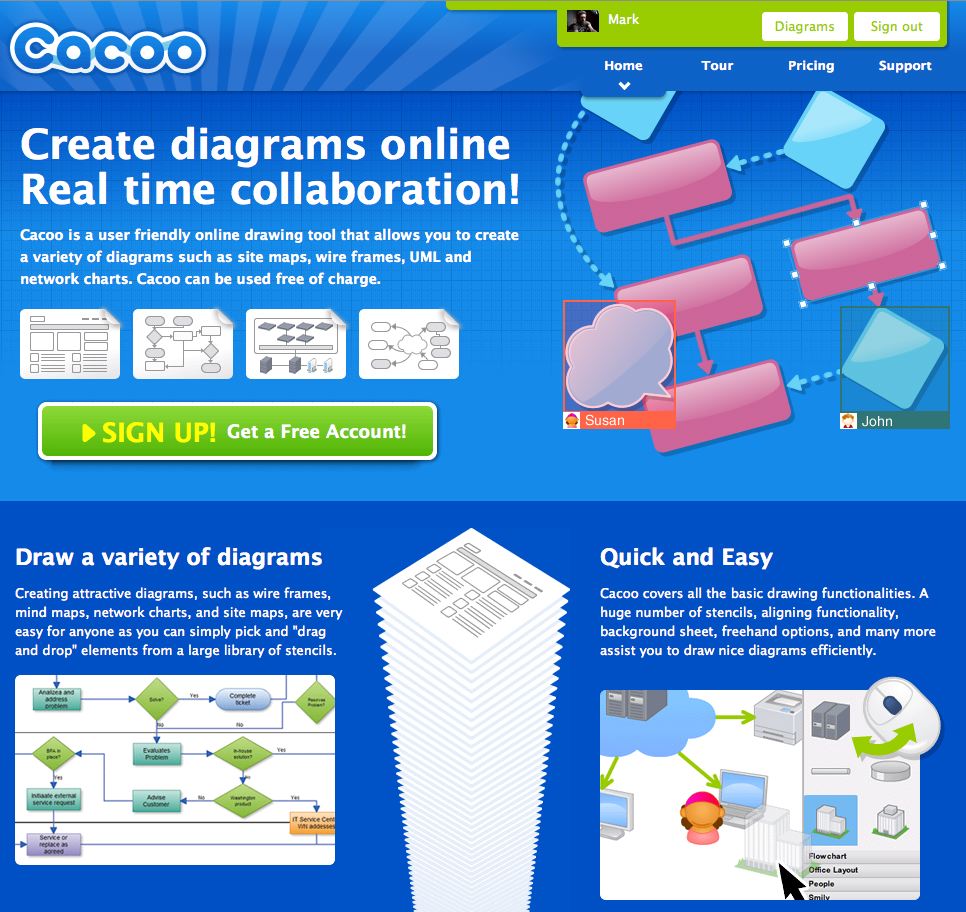
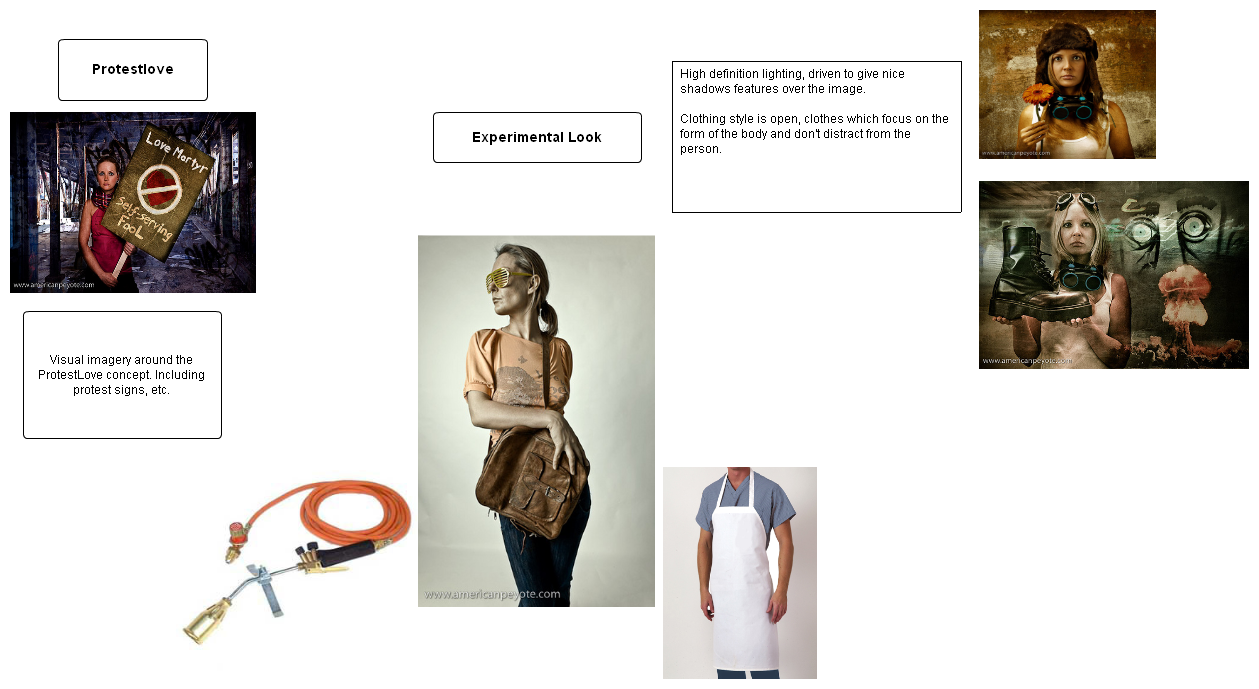
Photo Shoot Planning With Cacoo

Like many things on the net, I have no idea where I first heard about Cacoo (via a link from somewhere sent by a someone I suppose), but it’s one of the most uniquely useful websites I know of. A startup from Japan, Cacoo is like an online diagramming tool, like an online version of OmniGraffle, which is the best diagramming software for the Mac. With the free version of Cacoo you can create complex and beautiful diagrams, mindmaps, wireframes, page layouts, etc. and share them with a few clicks to people, and even do real-time collaboration. With the paid version, you can do exactly the same, just with more diagram pages (free version is limited to 25) and exporting options.

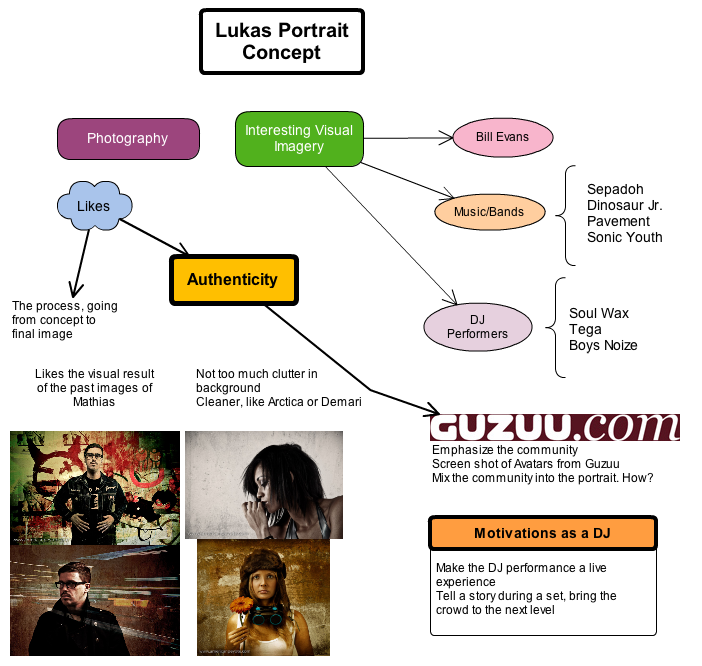
I started using Cacoo for photo shoot planning as a way to communicate with clients and collaborators. This seemed like an ideal use, as it allows the photographer/creative director to keep a history of project concepts to communicate directly to the client, and to be able to access and modify whenever desired. For photo shoot planning the workflow is like this: I have a concept meeting with a client where I get to know them – we toss ideas around, and basically just brainstorm. Then I take my notes from the meeting and create an idea map on Cacoo, detailing the type of portraits I want to create, and how the shoot will come together. You can view your diagrams directly on Cacoo, or export as a .png, .pdf., etc. The diagram can be shared securely with collaborators on Cacoo (with a Cacoo id) or via an open web link.

Why Plan?

For creative projects, often you want to communicate how an image will look like to show models/clients/collaborators what to expect during the shoot. With Cacoo clients can review your proposal, understand your thinking, and provide direct feedback on their desires. This allows photographers and clients who don’t have a lot of time to meet face to face to share ideas and give direction to a project any time of the day. It also builds confidence, because your clients see exactly what you want to do with them, and they’ll have confidence that you know what you’re doing. This helps to establish Trust – and there are few things more important during a shoot. If the MUA doesn’t trust that the photographer believes that the models know that they trust what they’re doing, then people become unsure of themselves and the end result can be lame. There’s nothing worse than going into a photo shoot without a clear idea of what to produce and just trying to throw something together in the moment under the guise of being creative. In the studio I create my decisive moments, I don’t wait for them to randomly happen. I find it’s 100x better when the clients, models, and makeup artists all know what will happen (or at least have a good idea) before the shoot starts. Photo shoots are collaborations, and the more input you have from the folks you’re working with the better the final images will be.

Planning With Cacoo

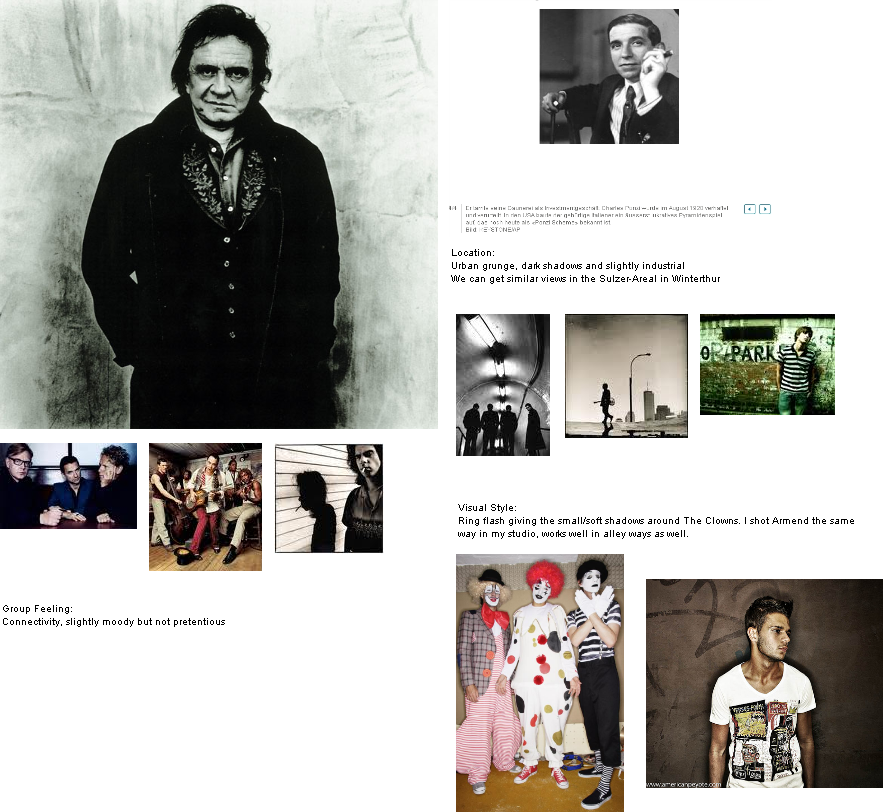
Cacoo is basically a large collection of wireframe objects and stencils that can be connected to one another while text and images can be easily added. With photo shoots clients often have an idea of what they want, and they can upload images that they’re inspired by via a weblink or direct upload to a Cacoo diagram. This makes it very easy to communicate with models or makeup artists so they know what will be expected of them for the photo shoot. Upload images of a shirt you want a model to wear, upload a hair or makeup style for the MUA/Designer to create, everyone can get everything ready before the shoot. I now use Cacoo anytime I need to communicate with models, clients, makeup artists, etc. It’s probably one of the most powerful free tools on the internet, and if you choose for a paid account, it’s probably the highest return on investment you’ll get anywhere on the web. Will Cacoo help your communication with clients? Hard to say, but it works brilliantly for me. Clients who are more web savvy will love it, and it’s a great way to get feedback from everyone involved in a potential photo/video project. Other folks, who aren’t so web savvy probably won’t be so into it. But, at the very least you can use Cacoo to show your clients exactly what you plan on doing before they step in front of your camera. Here are a few examples of how I used Cacoo on two different projects: Web Portraits Zurich and The Formers.

Case Study: Web Portraits

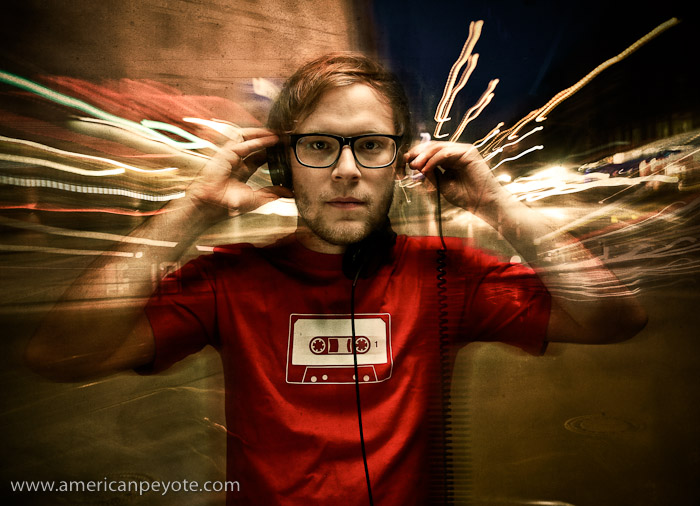
 With the Web Portraits Zurich project, I wanted to create cool portraits of people in the startup community around the Zurich area. I used Amazee.com to setup a group for the project and to communicate with members who were interested in participating. For each person we would have a brainstorming meeting, and then I would create a Cacoo diagram. This would often include sample images from my side so they could see what to expect from the shoot. Again, this gives people who likely have never been on a shoot before the ability to see what will be coming and to mentally prepare for the event. It also let them provide feedback to me on what they would like to have. On the main project page on Amazee (Web Portraits Zurich), I include Cacoo diagrams with portraits from each shoot, showing what we had in mind during brainstorming, and then you can check out the resulting images. Having these project diagrams also allows me to form a nice time-line, showing how the portrait project evolved. As a photographer it’s very helpful to look at what we had planned originally, and then compare it to what we ended up doing during the shoot, and what I ended up producing for the final images.

Case Study: The Formers

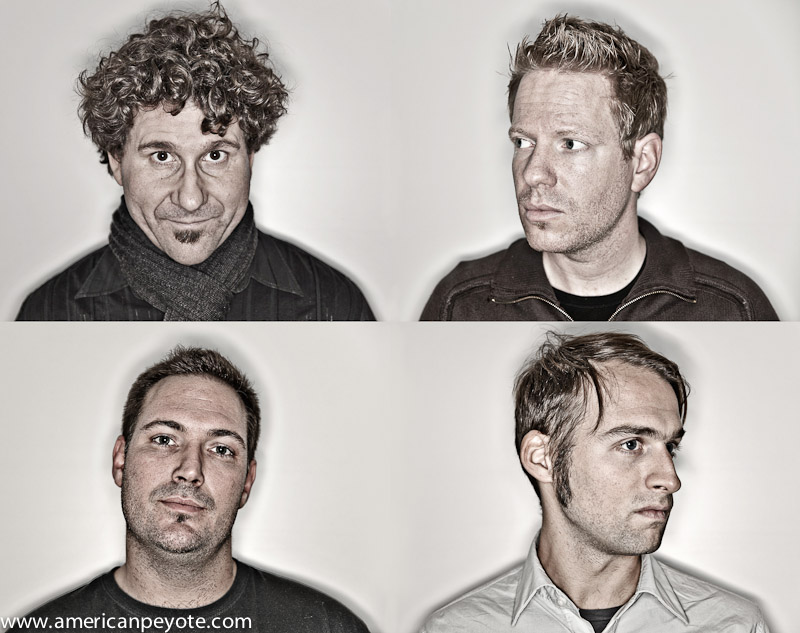
The Formers are a band from Zurich that I was contracted to do some portrait/video work for. They had some ideas for the overall feeling of the portraits they wanted, and we used Cacoo extensively in the pre-shoot planning process. First I made a Cacoo page for them and they uploaded imagery that they liked. Pictures from Johnny Cash and clowns, urban cityscapas, this showed me the way they wanted to represent themselves. This was a huge help for me as the photographer, because defined a direction, which was in line with the wishes of the band (we didn’t have time for meetings with the whole band before the first shoot). After our first portrait session Cacoo was used to get feedback on some composite image ideas I had, and also as a sounding board for new ideas. We liked the grittiness and sort of darkness of the images from the first session, and I dropped by their jam session to do another round of portraits. The results were tack sharp and exactly what I wanted. Cacoo allowed us to do a lot of this collaboration work on the fly, and reduced the time needed for organizational face to face meetings. I love meeting to brainstorm ideas, but it makes less sense when you’re just reviewing images or setting a date for the next shoot. Cacoo helps build trust with the people you’re working with, helps pre-visualize the results, it’s basically just awesome.

Amazing Value

Cacoo is really a fantastic value. By comparison, a standard license for Omni-Graffel costs $99 and isn’t on the web anytime you want to use it (although in a sense they address different user needs). The only drawback of Cacoo is that it’s not HTML5 based, and therefore doesn’t fly on the iPad (but I have high hopes it should work now or eventually on Android devices like an Asus Transformer). If a Cacoo app ever comes out for the iPad/iOS it’ll be a big hit. Aside from photo shoots, Cacoo is really great for anything where ideas need to be visually communicated from one person to another. For UX/UI design feedback it’s a great tool for creating wireframe designs of software or web applications. There are pre-made icons for Android and iPhone app design mockups, and you can now create your own stencil libraries for custom diagrams. For UX feedback, you can take a screen shot of a webpage and annotate it, showing what changes should be made in a conversation with your designer. Many new applications have been launched in the past 3 years, but Cacoo is by far one of the most valuable. I highly recommend it if you’re into online collaboration and idea sharing.

Polaroid Pinhole Camera Recipe

This is a story (or a tutorial) about creating a Polaroid pinhole camera. The initial motivation was to make a pinhole camera for use with a 6 grade class to teach them all about optics, but the camera is also super fun for me. This is my first experiment with a Camera Obscura imaging device, or commonly called: pinhole photography, one of the most accessible high-technologies of this and the last century. It’s a way to create interesting images without an expensive camera, and is an excellent way to demystify photography.

Kids are easy to impress, you give them a smart phone and they’re all like, oohhhhh, awesome, and you can make pictures with these fantastically plastic devices. But with a smart phone you have no understanding at all about what’s going on. Even most folks with a digital SLR probably don’t have a great concept about light capture and the reality that the physics behind your super amazing 24 megapixel Sony A900 can still be boiled down to nothing more than a very advanced light box. That uber-awesome Carl-Zeiss lens is built to high standards, but all it does is focus a little light on a light-sensitive surface – and with a pinhole camera, we don’t even need glass to focus the light.

The Idea

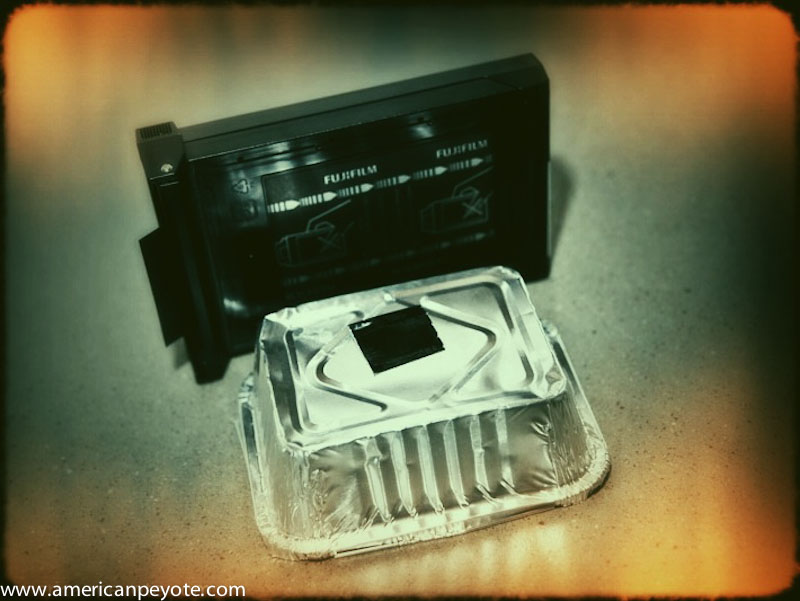
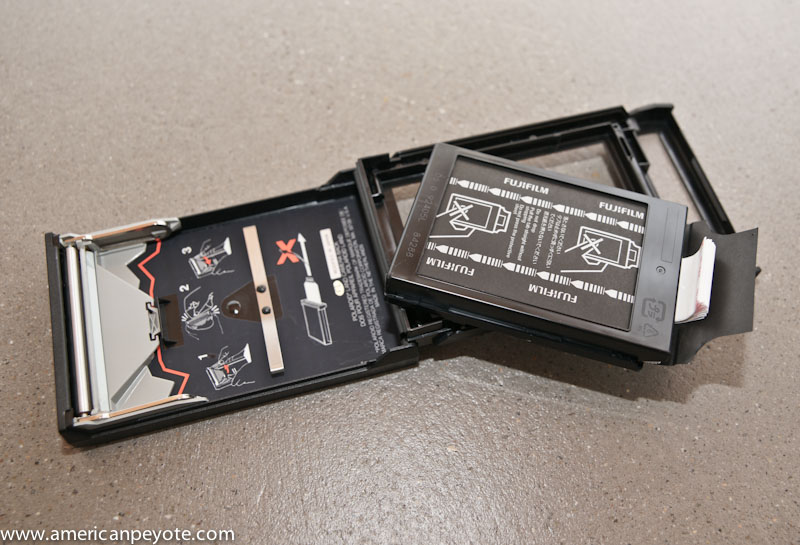
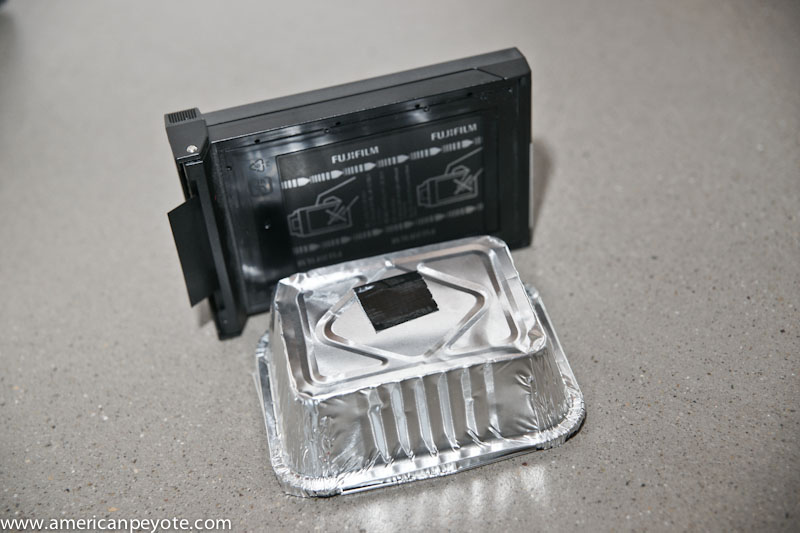
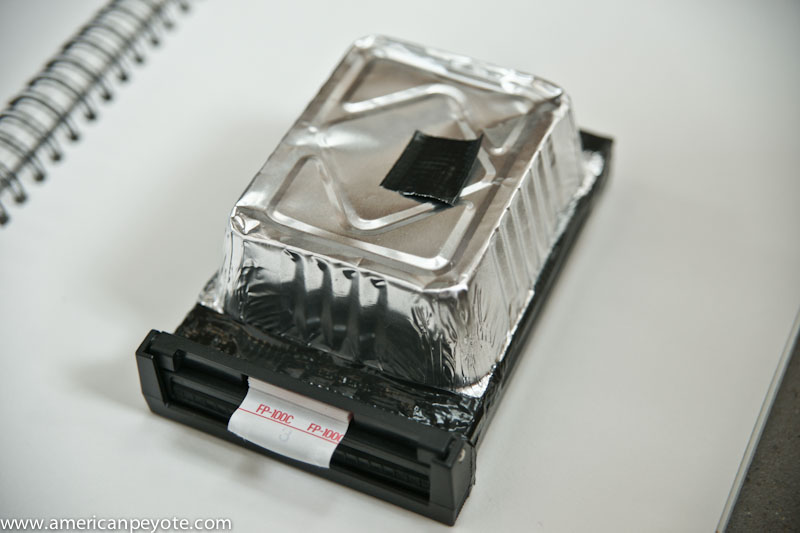
Originally this pinhole idea was for a school project, and I wanted to have something as cheap and easy to build and use as possible. While researching Polaroid pinhole I found a tutorial on Flickr where you put a piece of Polaroid film into the back of an aluminum container to build the camera. This is the cheapest way to do it and works well enough, but you need to change the film in total darkness. You also need a way to press the film correctly to apply the developer to the image, requiring the rollers from an old Polaroid back. Sure, we could do that with a light-tight tent and a rolling pin, but I wanted something more…instant. Also something with fewer things to go wrong to demonstrate the concept to the kids before they built their own. So, I looked at what I had in the house, and I ended up taking apart a Polaroid film back from my Mamiya 645 camera and then taping the aluminum container to it. I painted the inside black with spray paint, and then pressed a pin through the front before taping the film back in place. Hence the name, Polaroid pinhole camera. Now, you can also do things like measuring the pinhole (possible using a projector) and do some calculations to know your exact exposure for your film, but I didn’t feel like doing math and just took the camera out to shoot around Zurich with. More anticipation for the result, less thinking, more fun.

Polaroid Pinhole Recipe

  • Aluminum tin (or box, or whatever)
  • A Polaroid back (any one that accepts film will do)
  • Black paint (choose another color for interesting effects)
  • A pin
  • Polaroid/Fuji Instant film

The aluminum tin or box you buy from a supermarket or find in your house/apartment along with the black paint and the pin. The Polaroid back you can find on eBay (probably the cheapest) or the used departments at places like Keh or Adorama. You can probably also buy an old Polaroid camera and rip it apart for the film back, but that sounds a tad aggressive. Once you have a Polaroid back, you need to remove the front of it. Why? Because these backs are designed to show film areas for 6×4.5 or 6×6 (depends on the back you have), which are smaller than the Polaroid film area, and you want to use the whole piece of film. On my Mamiya Polaroid back I just removed the rubber backing, removed a few screws, and could then pull the face off of the back with out creating any permanent damage. The loading area for the film was perfectly intact, and ready for the pinhole camera body. If you want a wide angle camera, the distance from the film plane to the pinhole should be 2-3 inches, and will correspond to about a 20-35mm lens from a 35mm film camera. If you want more of a telephoto just use a box with a larger distance.

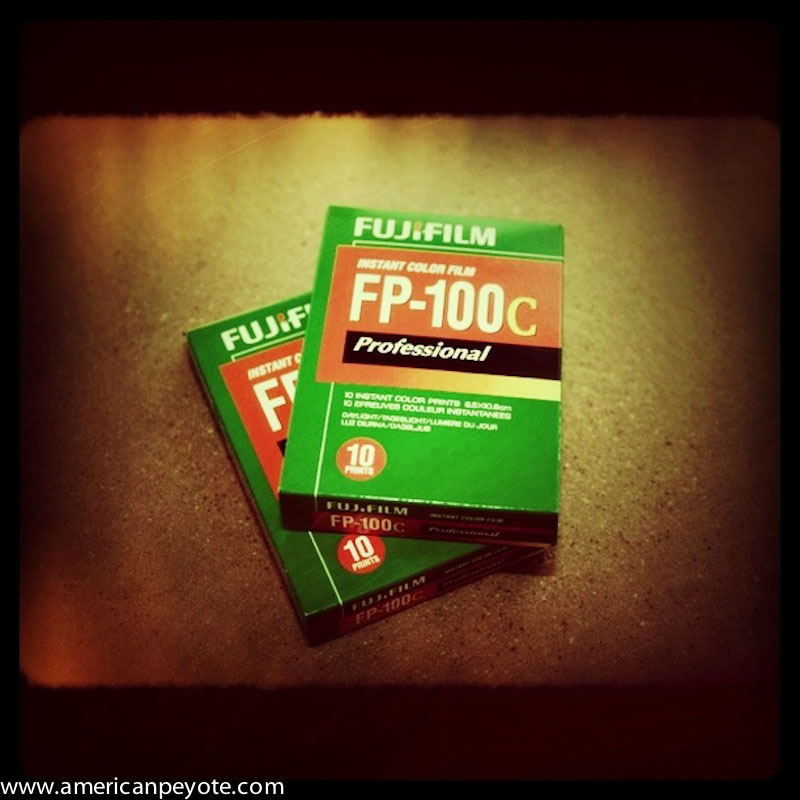
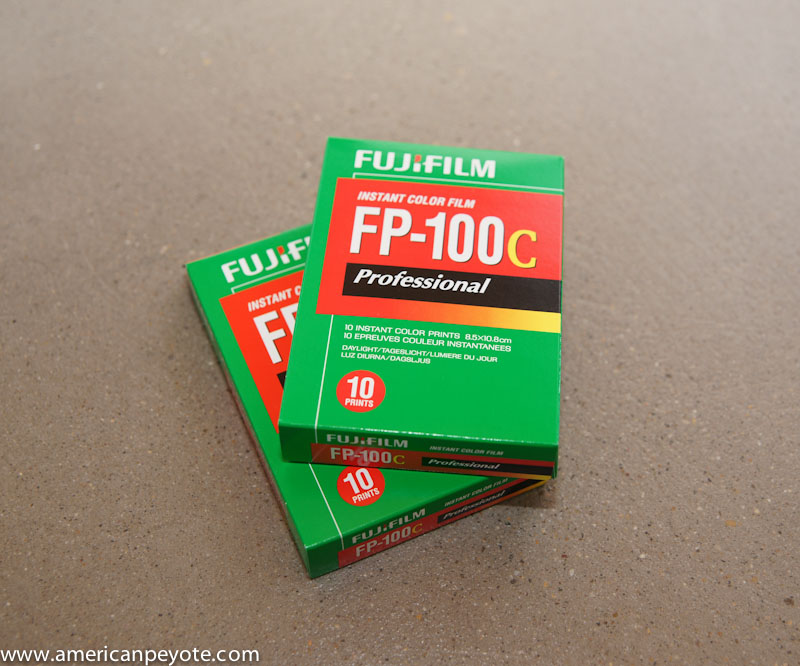
The film isn’t too hard to get, even in Switzerland. You can get Fujifilm or Polaroid. Now, there are two types of instant film from Fuji, one for legacy Polaroid systems, and one for their new Instamatic line. These are not interchangeable, and you want to buy the legacy Polaroid type, otherwise it won’t fit in your Polaroid back. There is also the Impossible Project, a company which makes Polaroid film in various flavors like black and white. The Impossible Project products are direct copies of the now discontinued Polaroid films and will work well with this system. The Fuji however, will be the cheapest and easiest to find, and I would recommend going with the Fuji to start out with to perfect your technique.

What comes next?

I’m having a blast with the Polaroid pinhole, but I see room for biggering. First, I want to start shooting portraits with strobes. It’ll be easy, just take some flashes along, set them up as desired, and trigger them by hand for the shoot. Second, is biggering to a Fuji 4×5 Polaroid back. This is a back for 4×5 large format cameras, and can be found on eBay or in Japan via the Japan Exposures webshop. This will allow me to easily use a larger film size, which can be easily bought in color or black and white from FujiFilm. Excessive? No doubt, but should make for an interesting project.

Analogue to Digital

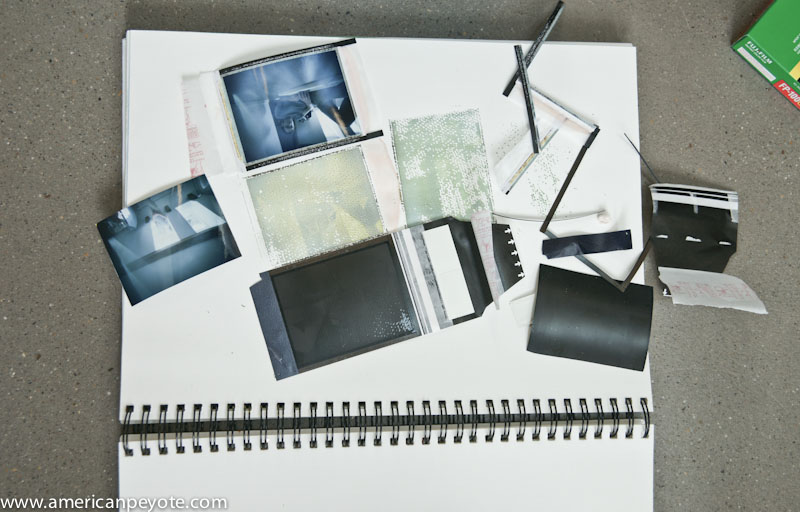
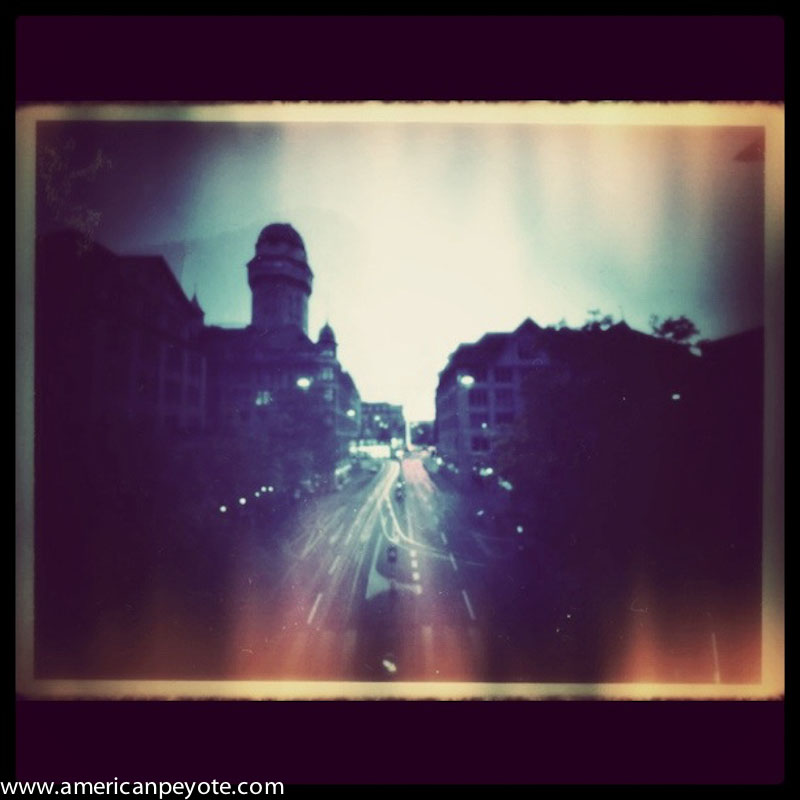
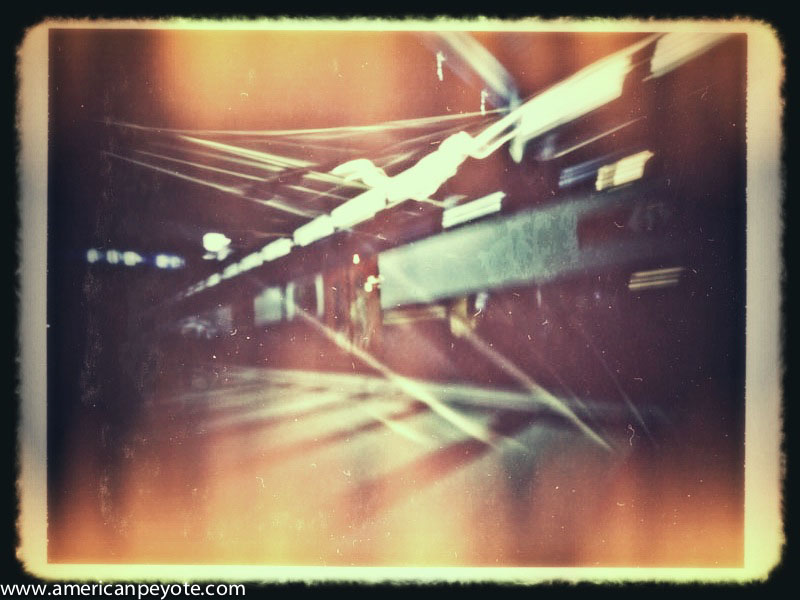
Once you have your fabulous pinhole images, you might still want to share them with those kids with the smart phones. And on smart phones, you might want to make them look like classic faded Polaroid images, as has become oh, so, so popular with Hipstamatic/instagram mobile apps. I like to scan my image on a flatbed scanner (I have an Epson 4990) and then transfer it to my iPod Touch. From there I run can run the image through Red Giant Plastic Bullet, and then instagram, where I can easily upload to Twitter and Tumblr. For more info, check out article: My Favorite Mobile Photo Apps for iOS Excessive? No doubt, but I don’t like to use just one imaging technology. I mix, I match, and I love the ability to apply the classic Polaroid look to Fuji-instant film on an image captured in a aluminum box and processed on my iOS device. In closing, here are some images showing the disassembled Polaroid back, painted aluminum camera body, assembled camera, and example images.

SwissAlpine K42 Marathon Report

I paid for the ticket and decided to run the race. I finished the SwissAlpine K42 in just over six hours. 1800m up, 1600m down, 42 km from the start to finish, my first marathon experience and enough of an adventure to peak my interested in future races. SwissAlpine, more than a race, but sometimes it’s mostly a walk. Here are my thoughts on the race. What it was like running the highest marathon in Europe – what I learned, what worked, and what comes next.

But First: Why?

Running a marathon makes as much sense as climbing a mountain – there is no point to it. Why put your healthy body through such a torment when it’s not going to directly help your survival in this life? For the sense of adventure and accomplishment, an honest answer indeed. I didn’t decide to run the marathon for any particular reason except that my girlfriend suggested it, and I agreed. Although there’s no point in it, it seemed like an interesting challenge, my nose smelled a wisp of adventure and I was committed. I’ve been living in Switzerland for going on 8 years now. Hiking in the Alps turned into mountaineering, I like to ski tour, sport climb, and just generally enjoy finding adventure in the mountains. I don’t really feel a need to run anywhere however. There are no ghosts from my past I feel a need to get away from and I enjoy taking my time strolling down the streets. The draw of the SwissAlpine was to see if I could do it and to feel like an American hero. Of course, this was all in my head. When you stand at the foot of a mountain, the brain will always tell you to turn back. It is the concept of failure, of not being able to climb a crack to summit that makes mountaineering interesting. I like the idea of moving fast over rocks and across wide distances like I can do ski touring – and if you drop the weight of a climbing pack and use light shoes, you have this wonderful combination of speed and can experience the mountain environment in ways only mountain goats and lions know. Plus, you get to wear awesome running gear from brands like Salomon.

Training

I started with the best intentions, and began training for the SwissAlpine back in May. I ran in the mountains around Zurich like the Hornli, and then Rigi Kulm and even headed to Bettmeralp to train at altitude. I found that I could generally maintain a pace of 500m/hr elevation gain and I only trained on vertical ascents, not focusing so much on flat land running. Then an emotional bomb exploded in the start of July and I spent the rest of the month pulling out of the heart breaking madness. For nearly all of July and most of June I hardly ran at all. However, I subscribe to the notion set down by Hunter S. Thompson, that if you buy the ticket, you take the ride, and I set out with the goal of finishing the K42, and a day or so before affirmed in my head that I would go to Davos and do this thing. The morning of the race, July 30th, 2011 I heated up some pasta and took the three hour train trip to Bergun, a little mountain village where the race would start.

Bergun – Kesch – Pass

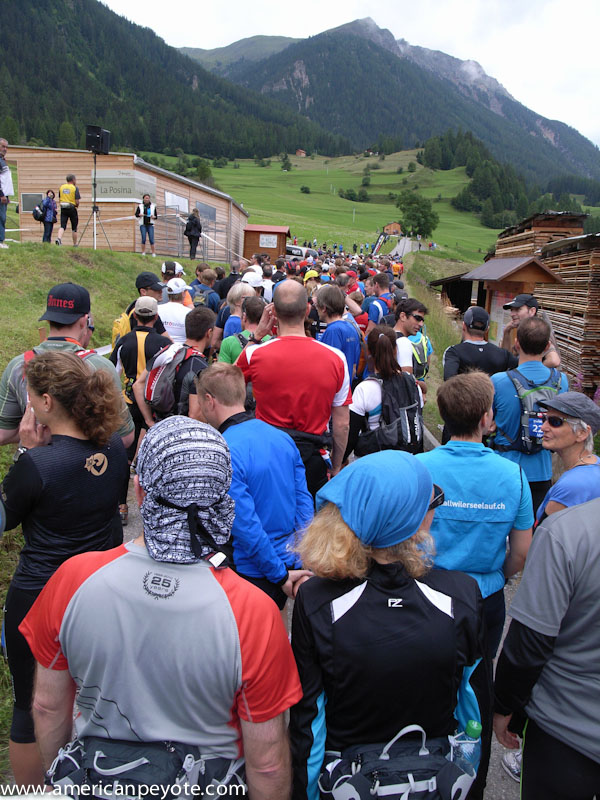
I felt good waiting for the race to start in the little mountain village of Bergun. I had a start time at 11:30am (for those of us who would need more than five hours to finish). The speakers blared some music I can’t quite remember, it could have been “you’re never gonna keep my down” but it’s irrelevant now. My mind was lucid, but with a determined focus sitting in the back of my primal brain. The purest times in life are when you know that you’ll embark on an adventure, but harbor few expectations for the outcome. Then it was time, and we started running. We started in a field of the village and then went through the main street. From the onset of the race I was getting passed right and left as we exited Bergun and began ascending in altitude. I expected this – I hate running on pavement. I was a little bummed at the start of the race, because we were running on pavement and asphalt, the reason I don’t normally like running races in the first place. “Get me off this dammed surface and onto some rocks” I thought. After a few kilometers we started the ascent up the mountain along a little river, and the trail turned to compacted earth and rock. At some point, everyone around me started walking, and I did as well. This was the point that I started passing people on their rights and lefts. I hate running on flat pavement, but love going up mountain trails. By walking with a long stride I was actually able to pass some people who were still trying to run up the beast. My training was in mountaineering you see, so I had no problem maintaining a quick walking pace up to the hut. Sure my legs were getting fatigued, but normally I’m doing an ascent like this with a 20-30 kg back on my back and mountaineering boots on my feet. The biggest hassle was trying to pass by people on the trail who didn’t see the point in standing aside and letting me go by. Beyond the river our path began winding through the trees and wisps of the cool mountain air began permeating my skin. There were clouds in the sky, but the sun was warm and I wondered why I had taken a jacket in my pack.

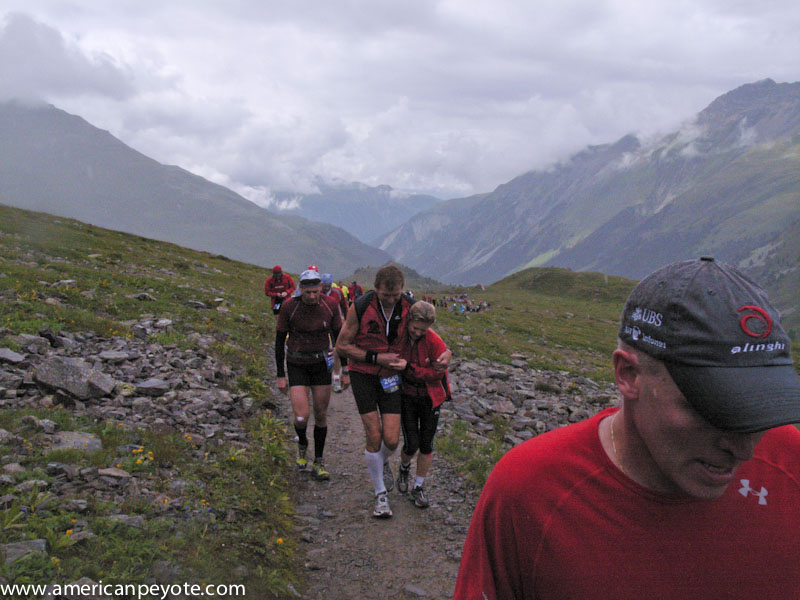
As the woods gave way to alpine loveliness the landscape opened up. That wide rocky expanse flooded my soul and I felt at home. Now we were on the mountain hiking trails above 2000m, climbing up to the hut – the high point of the race at 2625m. On these trails it’s easy to lose your sense of time and think you’ll be there forever in a perpetual quest for the end, but then you turn a bend and catch a glimpse of the hut, it gives your body hope – and you try to run a little way before your lungs complain about the lack of oxygen. The weather on the ascent up to the hut was rather nice. A little bit of sun and nice cool temperatures, perfect for my body type. They checked us at the hut, looked into our eyes to see if were still coherent or not. My lungs were feeling fine and my legs didn’t want to sit, it was far easier than some of the 4000m peaks I’ve ascended. I contemplating stopping to rest, but only stayed long enough to put on my jacket as a wind was blowing from the ridge. From the hut we had to descend down and then climb back up to the pass. The fun was about to begin.

Over the Sertigpass

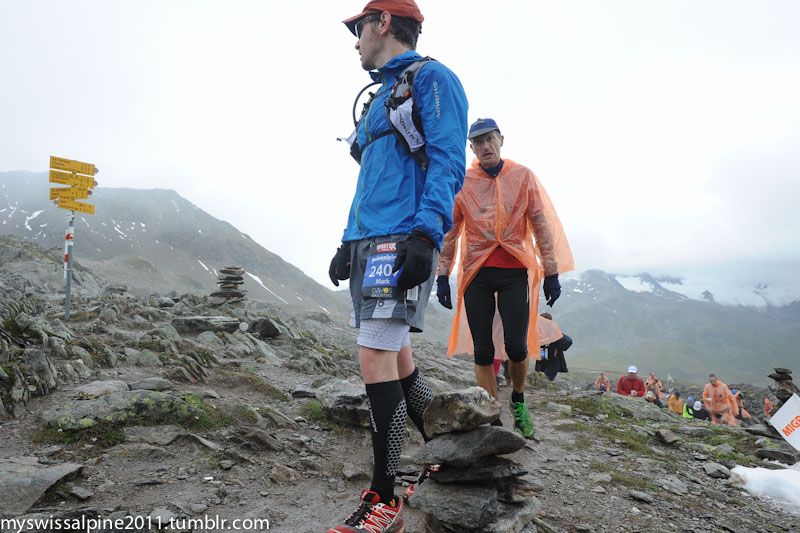
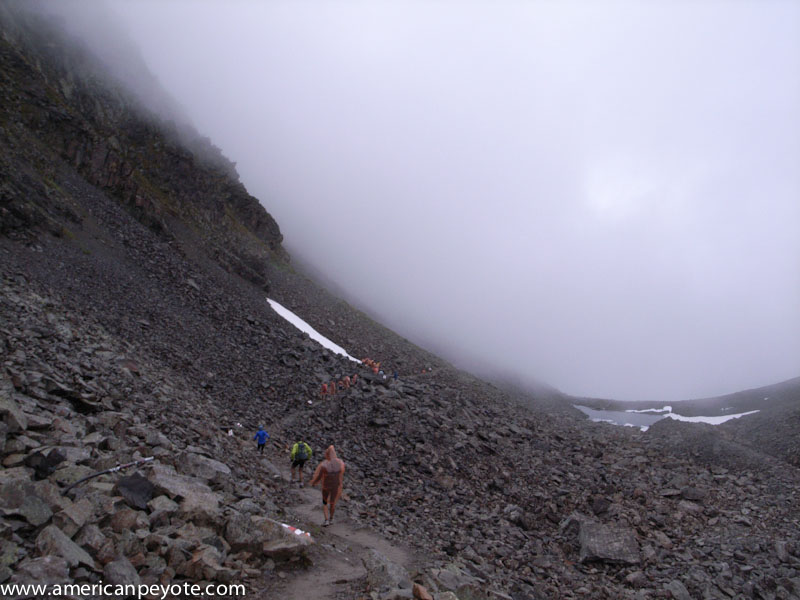
From the Kesch hut we had to descend to the mountain plateau and then up to the Sertigpass. Often times one side of a mountain looks fine and the other is grey and cold, and that’s what we had here. After the hut the wind was blowing and it started to rain on the way to the pass. For me this is the best weather to run in. I love it when it turns nasty, clouds envelope the ridges and the Gods start to forsake you. Your body is more efficient when it’s a little cold. Muscles don’t overheat, you just need to worry about tendons and ligaments losing elasticity, making an injury more of a risk. I just put on my super light Salomon running jacket and Mammut gloves and was good to go. Most folks on the race had nothing but their shorts and shirts, and wrapped themselves in the light orange ponchos the organizers were handing out. I couldn’t imagine running up a mountain in shaky weather in only light shorts and a T-shirt, but I guess it’s what a lot of people like to do. I prefer staying warm and flying down the mountain trails like a half-human mountain goat super hero. In the future, I’ll pick up a pair of Salomon running pants, probably the 3\4 length version – it would have been better to keep my knees warmer.

I think the cold and terrain was a torture for some people, but I relished in the nastiness. This is my environment. My body is tuned to survive when the weather wants to kill you. My only challenge was trying to pass all the people on the mountain trails. These trails are only for one person at a time, and it’s hard to find room to overtake, but I’m a resourceful basterd. See, most folks had basically no idea how to run down on mountain trails, and that is by far my greatest strength. Running down hiking trails is what I excel at. It’s sort of a combination of dancing and climbing technique. I get into a rhythm and my legs just dance along the trail. My training has been descending down those trails with a 30 kg mountaineering backpack, and when you remove the mass of the pack and put me in light trail running shoes, well…I can literally fly down the trails. I only saw two other runners who also knew how to jump along the rocks and float with the environment. Everyone else was going sort of slow, small little steps and trying not to slip. They would avoid all the big rocks and timidly step down the trail. I on the other hand would jump from one rock to the next in long strides and sometimes float for 2 meters of trail in the air before the next foot placement. I was easily gliding past runners and felt like a bird. Rocks are your friend on these trails. The big ones are the best, you only need some decent shoes to grip a bit (and the Salomon shoes were excellent for this), and then just let gravity pull you down the mountain, hopping from rock to rock to maintain direction and to control your momentum. I was a super hero. I was spiderman and I felt an amazing sensation of freedom and quiet calm letting my legs navigate the trail like a jigsaw puzzle that I could solve without thinking. Then the descent ended, back on the normal trails were the fun ended.

The Long Run to Davos

I probably sound like an arrogant cocky prick describing how easy it was to pass people on the ascent and descent, but that’s just my environment. Running on a flat surface is by far my largest weakness however, and after we got off of the mountain trails I was again getting passed right and left by folks who seemed to know how to run a marathon. After the descent from the pass the race was just another 20 or so kilometers to Davos Platz. The trail was basically flat at this point, descending gradually to the stadium and the finish line. This is where I slowed down and many who I had passed on the mountain were now going by me with large smiles on their faces. For the past 6 or 7 years I’ve been doing mountaineering and climbing. So my legs are highly optimized with muscle memory reactions for going up and down mountains, balancing on thin rock ridges, and going all day long, but I hate running on flat surfaces, my body literally doesn’t know how to do it (and has shown to desire to learn). Unless I’m sprinting my body doesn’t feel right and I would rather walk. On the flats your feet are just going the same way with the same stride, and my mind sort of gets bored and I think it would be more enjoyable to walk. In the future I’ll train more on flat runs to get the right stride and increase my flat stride endurance, but for the 2011 K42 the last 15-20 km is where I took the most time.

Heart Exploding Finish

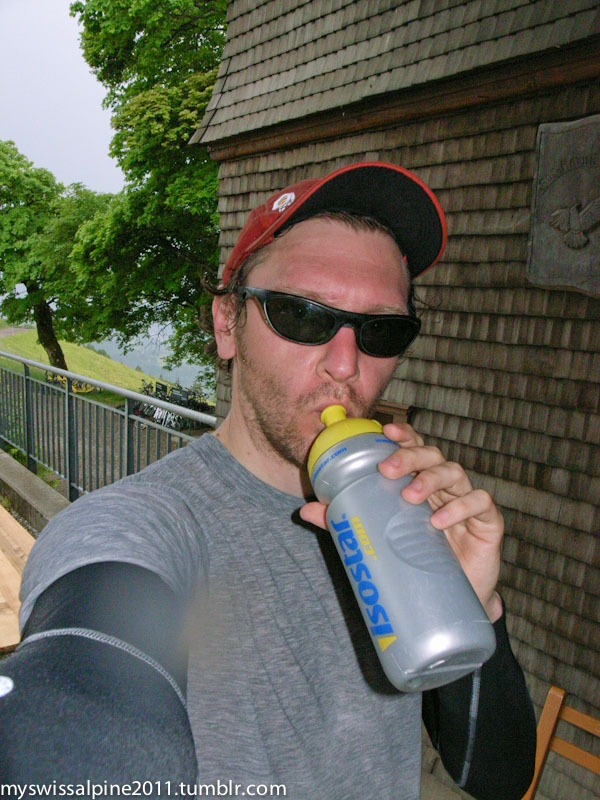
The last 15 km to Davos Platz were enjoyable (despite being mostly flat). Green and grassy, probably the easiest leg for most of the runners. Since this part is closer to the mountain villages, we were often greeted by random folks along the trails ringing giant cow bells – a fine motivation it was. The locals all seemed to show a great respect for us mountain marathon fools, and I thank them for that. A gradual downhill grade and drink stands with water and warm flat cola and random cow bells. Not a bad way to spend a Saturday. I started drinking the cola at this point, the Isostar mix I had in my backpack sort of tasted like banana and made my stomach ill. Eventually the valley opened up and you could hear the music coming from the stadium area – the finish. But it was also 7 or kilometers away. My energy wasn’t tapped out at this point, but I could feel the tension in my legs, and figured it would be a shame if I pulled a tendon on my first marathon, and walked a lot to go easy on my legs. At this point I knew I would finish, and wanted to do it strong.

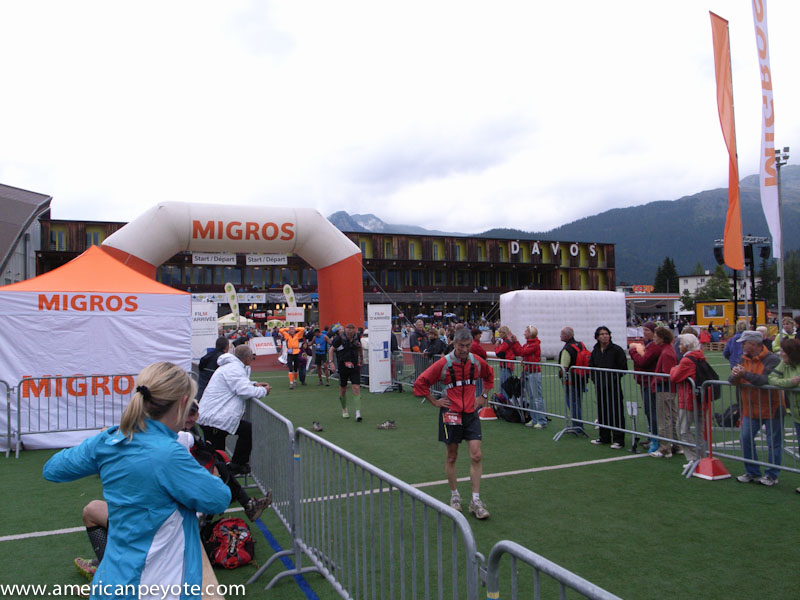
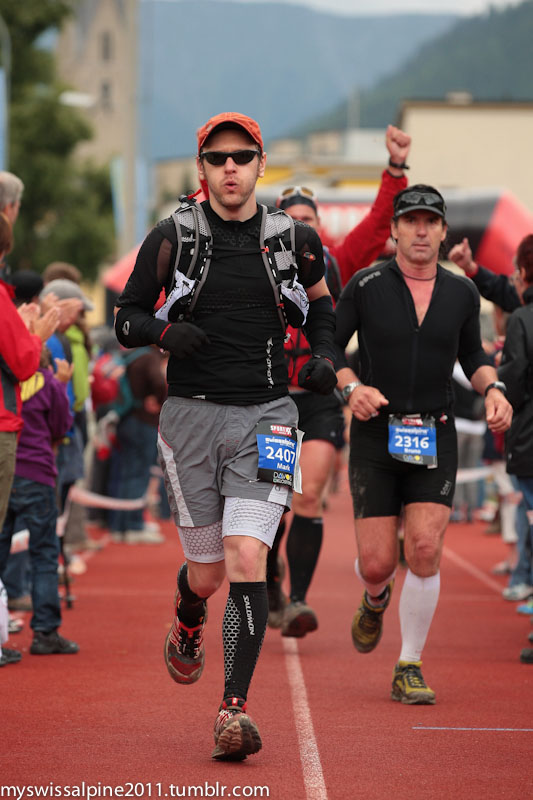
I know that with a marathon you’re supposed to ramp up your energy from start to finish, but I love sprinting to the finish line. This implies that I didn’t use enough energy during the rest of the race, and I’m fine with that. I ran the last 2 kilometers non-stop on flat asphalt (my least favorite thing in the running world) and when I heard a woman yell from the sidelines that it was only 500m to the finish I ramped up my speed. As I entered the stadium my lungs were exploding but I had some energy reserves and decided to push myself just a bit more and I passed a guy next to me as we ran around the track at Davos Platz to the giant Migros finish line. People were lined along the finish corridor cheering, and that energy feeds you like an adrenaline shot, and I had a fine sense of super-human accomplishment as I passed the final line and resisted the temptation to collapse. The official time was 6 hours and 6 minutes. 1800 meters up, 1600 meters down, 42 km all the way, the first time I’ve run more than 10 km in my life, the first race I’ve run since the last Detroit Turkey Trot I did back in 1998 or something. Was it worth it? Hells yes. Mountain marathons are a fun way to experience the Alps. Ascending fast, moving over the mountain terrain like a wind spirit and pushing my lungs to the limit at the finish was a fantastic feeling. Now for some thoughts on gear and trash.

What Gear Worked

Basically, all the gear I had worked fucking amazingly well. The Salomon running gear is just basically the most wonderfully designed gear you could imagine for the sport. The compression shorts and calf compression things really are like a second skin, breathing extremely well, and actually help to support your muscles. The Lab running pack feels like nothing on your back and I could trek all day and night with it. I also took a pair of Mammut gloves along, which are essential for me when the weather turns nasty. When it rains and gets cold you stand to lose a lot of energy via your hands, and a nice pair of wind-proof gloves will keep you comfortable when it starts to rain or snow. The light running jacket from Salomon was also essential. It’s super light, fits easily in a backpack or on your belt and actually keeps the rain off of your body. It has a hood, which was great and kept my ears from freezing. The Pearl Izumi arm warmers were fantastic as well. They retain heat over your arms even when it rains and you can pull them down over your forearms if you get too hot. Plus, all of this gear weighs next to nothing. And now for a scolding…

Pick up your trash

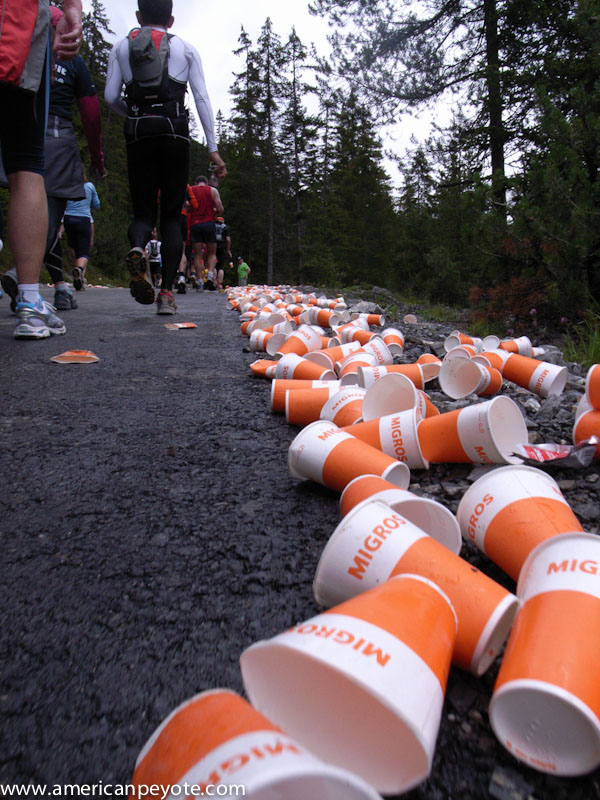
No, I get it, you’re running a marathon in the beautiful Swiss alps and you think you have the right to litter? Oh right, you’re just so exhausted, you just got a cup of water and it’s just too much trouble to drink it and put in the multiple trash cans so you just drop it somewhere along the trail? Really, are those few seconds needed to stop at the trash bag going to cost you the race? I think not, please pick up your trash and leave it at the next station. I can understand dropping cups near the water stations (like those nicely lined up in this photo), however, I came across a lot of things like empty power gels and rain ponchos along the race path, and it was sort of amazing to me that people would just leave their shit along the beautiful mountain trails. If you’re running in a city at least a cleaning crew can easily follow the race and collect trash, but it’s not so easy in the mountains. Just because you paid a race fee doesn’t give you the right to litter. See, it’s easy, if you consume a power bar or gel, then just stick the wrapper in your pocket. Is that really so hard? The next time I see someone just dropping their power bar wrapper on the mountain trail I may just push them off the side, but I guess then it would be even more work cleaning up the wrapper of their body impacted on the rocks, and…I’m not an aggressive person to start out with. I follow the ethos of “pack it in, take it out.” It implies that you’re personally responsible for the waste you generate and transport out of the backcountry. With my backpack it’s easy, I eat a candy bar, and then stick the wrapper back in the pocket, then I throw it out when I get to a trash can. Respect the mountains that your choose to run in…trash rant over.

The SwissAlpine K42 was an awesome race. It’s a fabulous was to experience the Swiss mountains and I can highly recommend it for those adventurous souls who like to run at altitude. Thank you to all the organizers, to Florian Kistler from Salomon for making awesome race gear, and to my girlfriend for suggesting that I run. What comes next? Well, I have a spot in the Jungfrau Marathon in Sept. It goes from Interlaken up to the Eiger North Wall and sounds like a fun time. The SwissAlpine was indeed more than a race, it was an experience.

My Favorite Mobile Photo Apps for iOS

The daily smart phone is the camera that’s always on you, and by definition the best, because you can’t put a Sony A900 in your pocket to take around all day. At the moment, I don’t have a smart phone, I have a passingly-intelligent Samsung, that I’m embarrassed to pull out at Web Monday gatherings. I do however have an iPod Touch, and now enjoy using push-button applications to post-process my photos when I’m not by my computer. Here are my experiences with what works, what I find awesome and lame in the world of mobile apps for photo processing. Here’s a run down on what works for photo processing on my iOS device, what doesn’t work so well, and why. The goal here is to have an app that adds to my Photoshop work, is fast and easy to use, and gives easy access to social networking sites for uploading.

First is what I want/expect from a mobile photo app: I expect the app to do something useful and valuable to my photography/art, which can’t be done on my iMac – or, which is more convenient and faster to do with the mobile device. I expect connectivity, so that the processed images can be quickly distributed to social networks and saved to my device/phone. We have three contenders here, Photoshop Express, instagram, and Plastic Bullet.

Photoshop Express

PS Express for your mobile phone is ok, but for my purposes it basically sucks for anything besides viewing images and making a few basic color overlays. I have a Photoshop online account, and had high hopes (now dashed) that I would be able to use the mobile app as a way to process and then distribute images to different online areas and social networks. Alas, the app is basically useful for nothing but a little coloring and an assemblage of near-useless effects that only detract from my work. I’m probably being a tad hard here, and admit to being a post-processing snob, but it’s Photoshop, and should be the pinnacle of processing power. PS Express actually has some useful features: you can rotate, crop, and do some other basic things like overlay a rainbow filter or reduce noise in your images (useful for crappy-exposure camera phone images), but these minor tweaks are no reason to spend the time required to download and open the app. Adobe made a fair effort here, there’s some more advanced functionality like a tilt-shift blur filter, but the transition region from sharp to defocused is abrupt, unnatural, and basically just ugly, making the app near useless for me.

instagram

Instagram is all the rage (so I’ve heard), it’s sort of supposed to be like a Holga for your iPhone, and processes your images in a classic faded Polaroid feeling and light-leaky camera profiles. For some reason we like to push the boundaries of camera technology and then process the images to make them feel old. It’s a fun thing to do and is probably fun to use with a camera phone…however, much like PS Express, I feel that the effects are sort of flat and uninteresting. Uninteresting in the sense that it doesn’t really add to the content (or feeling) of the original images, but generally detracts from it. When you apply one of the filters, the app will basically just overlay a color or processing effect on your image, maybe add a film border for nostalgia (which is an important feeling) but it doesn’t seem to really target or balance between shadows and highlights. The result is a flat image that’s sepia or sort of black and white, but that doesn’t improve upon or add to the quality of the base image (in my elitist opinion). Of course, I’m highly biased to color and form in this respect and make no excuses for mediocrity. I do my own Photoshop work and don’t mind spending an hour or two doing a basic image composition for one portrait, and although I don’t expect the same attention to detail from a free app – still, as a single app instagram is sort of uninspiring for me. But, we don’t have to use just one app, do we? The true value of instagram is the easy integration with all the relevant social networks and microblog sites. Direct from the app I can upload to Facebook, Flickr, Tumblr, etc. and I think this is why some folks use the term Killer when describing instagram, it does everything Flickr should have been doing with from the start with their mobile app. The usability of a social app like instagram is more important than the quality of the product (like the best camera is the one you have on you), and that’s why I still have the app on my iOS device, it’s fun to play with and easy to upload. But there is a better, plastic fantastic choice in the app world.

Plastic Bullet

Plastic Bullet, like many apps, simply doesn’t get the recognition is deserves. Plastic Bullet is developed by Red Giant, a company you’re ever heard of unless you’re into video/film post-production software. Red Giant specializes in software that aids in things like video time code transcoding, color correction and color grading of films, all made available at a price point realistic for indy film makers and startup video hobby directors like myself. Plastic Bullet is a product from the folks who develop one of the best color grading programs on today’s market, packaged as a mobile photo app, and I love it so much I’m using it to produce looks I can’t do in Photoshop (or at least, don’t want to spend time doing). Plastic Bullet is the only photo app I have that really adds to my images. The processing Plastic Bullet applies to your photos isn’t just a color overlay, it really feels like the app is improving the image quality and emotion of my images (when the right effect is applied). Shadows and highlights in the images are processed differently (depending on the filter you choose) and you can’t predict exactly what it will do until you start playing with images. Of course, it’s not a magic bullet. I need to give it a nice image to work with, and I then go through a few finger taps, picking the processing that works best, but in the end it creates a unique image. The cool thing is that you never know exactly how the image will turn out, and that adds to the magic of the whole process. It gives images a much better Holga/Polaroid feeling than instagram, and brings out new colors for different images. From the app you can save your processed image to your device or upload it to Facebook, or Flickr. I would love the ability to upload to Tumblr and to my blog as well, but I can also just save the image and upload it from my library. Plastic Bullet isn’t free, but it’s an app I would pay for (full disclosure, I got it for free during a promotion from Red Giant) now that I know how good it is. But why limit yourself to just one?

Why Choose Just One?

Since I have both instagram and Plastic Bullet, I’ve actually just started using both instead of picking just one. I like the overall feeling of Plastic Bullet, so I use that first, and then save the image and open it in instagram for further processing and uploading to the instagram social network as well as Facebook, Twitter, Tumblr, etc. Since instagram renders a less aggressive treatment than Plastic Bullet, it’s ideal as the final touch to tweak color levels. So with both apps I get the best of both worlds, tight social network integration and excellent color processing. I’ve started using this combination to reprocess old portraits, pictures of my paintings, cow photos, and I simply love it. Sometimes I’ll go so far as to process in Plastic Bullet, then export back to Photoshop/Lightroom on my computer and tweak the colors and shadows, and then send it to the web.

Don’t get caught up in the information overload. All of these things are just tools, and with all the ways to share files an artist shouldn’t feel locked into any one app or processing philosophy. Use the tools that you discover to achieve the vision in your head, don’t be blinded by the marketing hype and pick one over the other. The human imagination is too small for just one photo app.

Winner Announcement: Video Poetry Project


The grand video poetry creative invite experiment is going to the next level. I am pleased to announce that Bobby Cuevas is the winner. There were 15 entries from artists in different corners of the world submitting to the contest, and I had the opportunity to pick one to work with. Thank to everyone who submitted to the contest, it was truly an honor to see people creating music for the project, and using Talenthouse to connect us was excellent. The winner of the contest has the opportunity to work together with me on my next series of video poetry short films. I’ve never been in the position of choosing a contest winner, and in the end the choice was made on context.

Context

Judging creative work of others is a strange business, and in the end it comes down to tastes and context. There’s really no other honest way to do it. Something can be technically great but not be what you’re looking for. The context is the head of the person choosing, and isn’t something that can be predicted or necessarily designed for. This was one of the main lessons from the Professional Artists seminar I attended at the F&F Kunst schule in Zurich this summer. Art is bought in the gallery scene based on context. Is it new, does it fit with the gallery, is it maketable, does it create a reaction – and how does it do that in relaitonship to all the other art in the Zurich art world? Art doesn’t have value without context, and as the context changes, so does the value of the art.

Decisions Decisions

For the decision process, I mainly looked to see what the music would create in my head, and based off of how ambivalent or twisted those images were, I decided to go with that artist. I figured, the music which creates the strongest reaction in me is probably the best one to go with. This was a measure of how the work of the artists would match my work. There were a number of entries which were excellent, and I could imagine creating a movie with them, but just didn’t fit into the context of the project I have in my head. As an artist, the most important thing is to connect with people who like your work, that is the context in which you will be successful, and sometimes it just needs to be one or two people.

Bobby did a production called Coming Together, it starts with a cut from the song Come Together, and then drops into a drumming rhythm, it sort of bores into my head and remixing into a fluid menagerie that just mixes well with images of a Bratz doll 50 feet tall, walking through Detroit with a .50 Cal sniper rifle. It was the later part of the track that started pushing my neurons around. I could see a sort of blackness with interspiced flashes and a person walking down the street, the camera in my head did a pan and then a steadycam momevent around a guy’s face, then the scene was reversed in editing and then there was a robot fish crawling out of the ocean and started to walk.

So, I look forward to working with Bobby on a video poetry short film series. Thank you to Talenthouseadambriozaybudmanlollyjean and everyone who submitted to the video poetry creative invite.

Bobby Cuevas

Voting Open! Collaborate On a Video Poetry Project

Voting is open on the video poetry creative invite at Talenthouse.com! To recap, I have a creative invite running on Talenthouse, where the winner will have the opportunity to work together with me on a video poetry series of short films. I wrote about the contest previously, and now this wonderful experiment in online collaboration and general creativity awesomeness is coming to an end. Well, the first part, then will come the video poetry series. For the contest, I provided some images of inspiration, including images of Bratz and War, and the participants then needed to create a music track to submit to the contest. The highest voted songs will get the first listens from me, and I’ll then work with the winner (whoever created the best mix in my mind) if they’re interested. For the video poetry part, I’ll create some poetry concepts and shoot the needed video, and the winner can have their music featured as a component of the final videos.  It’s all very non-linear and experimental, but when you challenge people, excellent things always happen. The voting is open here on Talenthouse:

Voting Open: Collaborate with American Peyote on a poetry short film series

On the Verge: F&F Art Show at Rote Fabrik Zurich

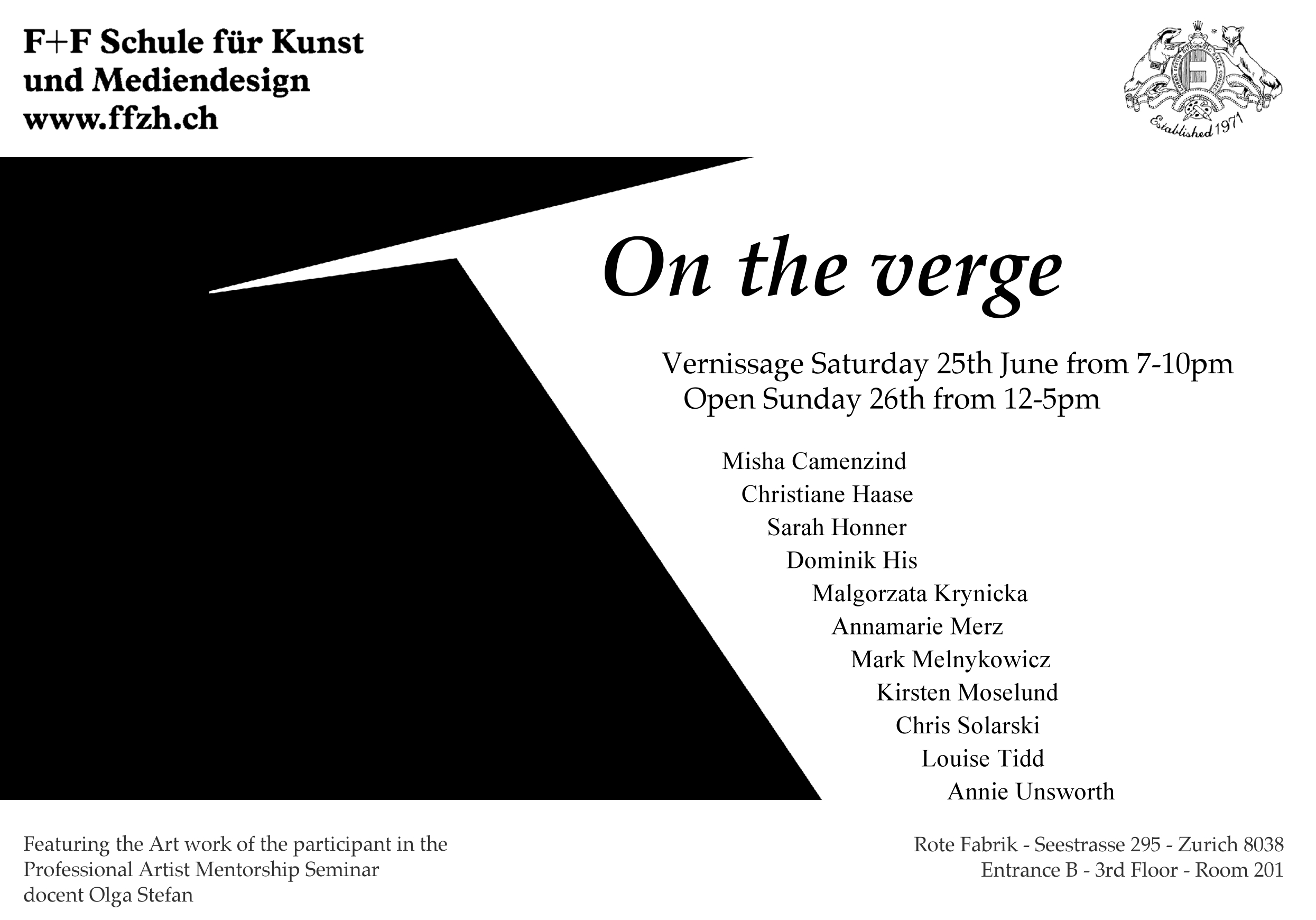
On the Verge is an art show, featuring the work of the artists enrolled in The Professional Artist Mentorship Seminar, docent Olga Stefan (F&F Schule für Kunst und Mediadesign). We will be showing at the F&F Schule by the Rote Fabrik in Zurich. Works will include painting, sculpture, installation, a video game and short films. We are artists on the Verge and this is the opportunity to see our work. We have a show over the weekend, with a Vernissage on Saturday night from 7pm, with the art fun continuing on Sunday 12-5pm. 

Feel free to drop by Saturday night before heading to Hive, enjoy a coffee lunch Sunday morning at the Rote Fabrik and then wander through our work at the F&F Schule. Artists will be on-hand to mingle and we would love it if you can join us. Promo video of the show is at the end.

Vernissage on Saturday June 25th from 7pm
Show open Sunday June 26th from 12-5pm

Rote Fabrik Zurich
Entrance B – 3rd Floor – Room 201

Artists Exhibiting:

Misha Camenzind
Christiane Haase
Sarah Honner
Dominik His
Malgorzata Krynicka
Annamarie Merz
Mark Melnykowycz
Kirsten Moselund
Chris Solarski
Louise Tidd
Annie Unsworth

SwissAlpine Training Days: Bettmeralp

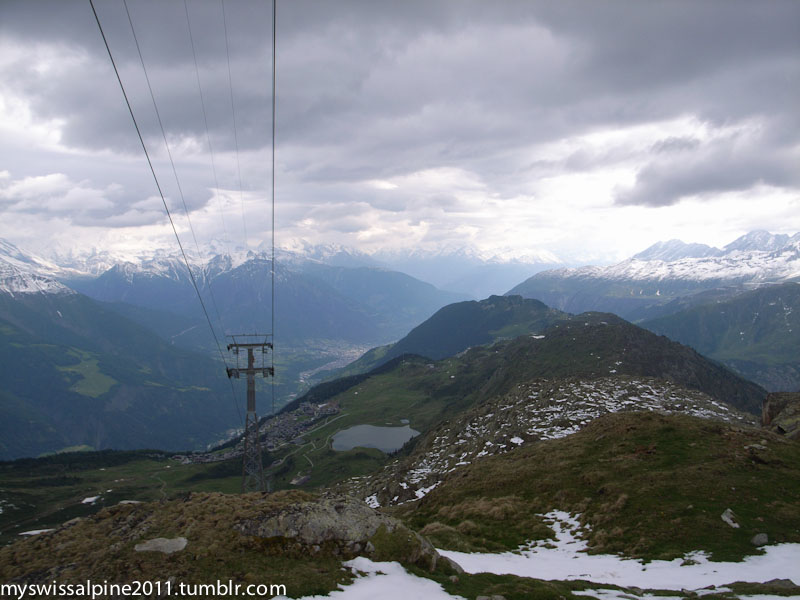
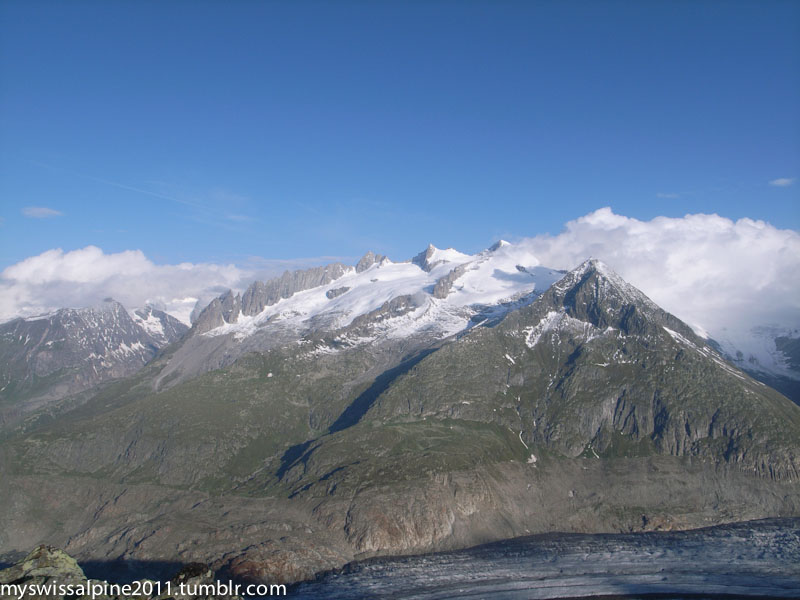
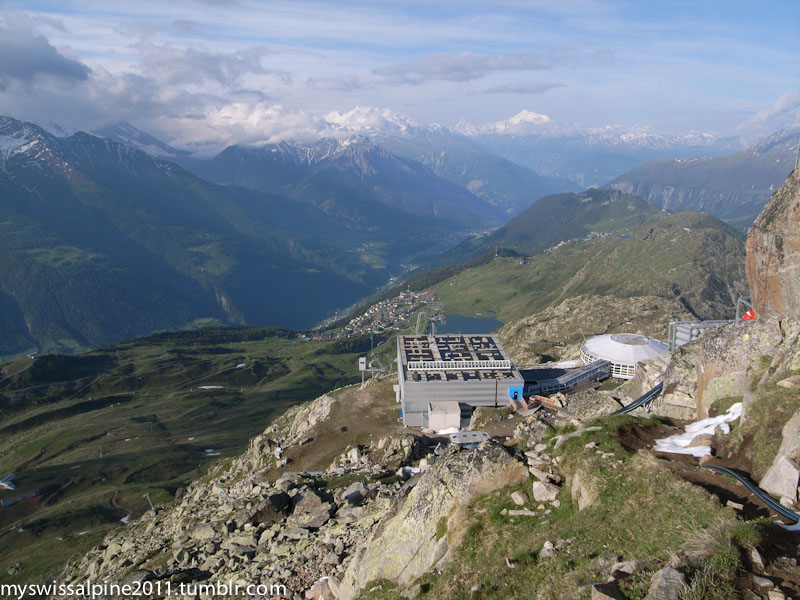
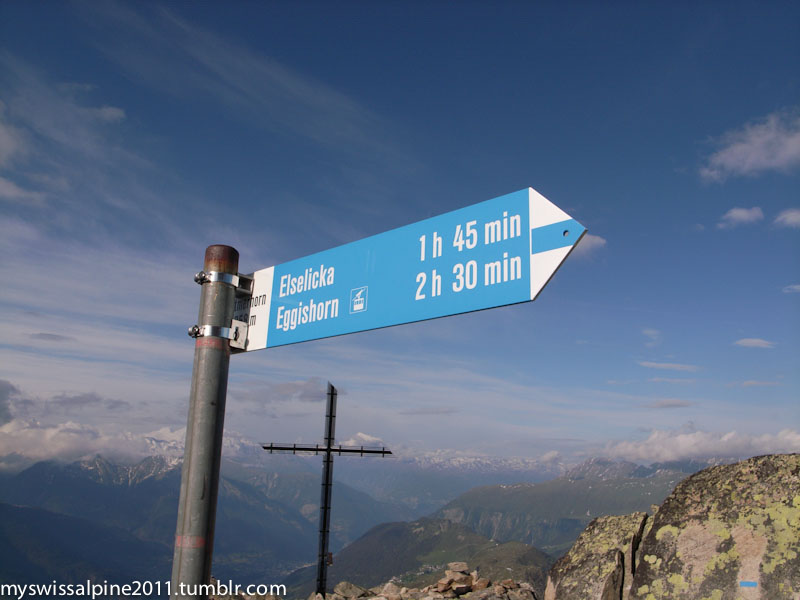
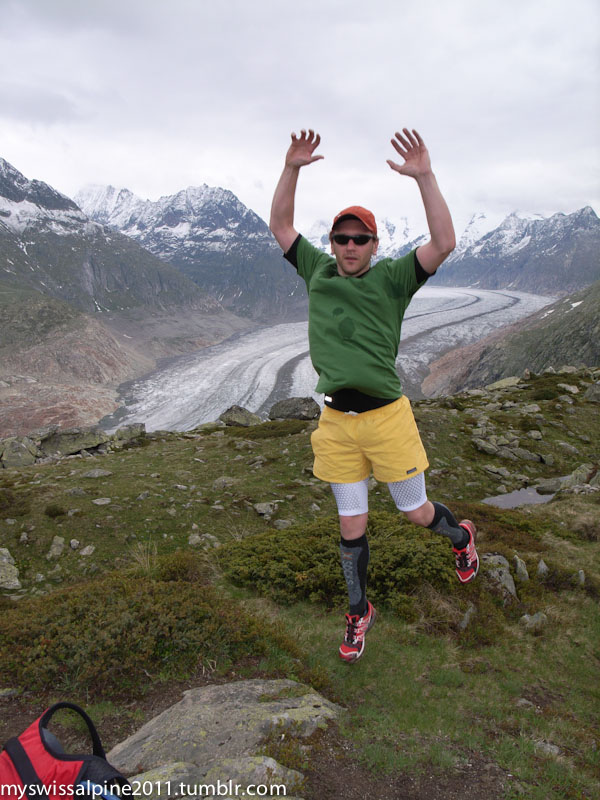
For my first taste of alpine running I headed to Bettmeralp, a little dorf in the Swiss mountains, on the footstep of the Aletsch glacier. Bettmeralp (the better alp) is an ideal running location, the accommodations sit at 2000m, and the ridge above the glacier goes from 2200m up to 2600m by the gondal station near the Bettmerhorn. To mix up the running with mountaineering, you can also go up to the Eggishorn, which sits at a comfortable 2900m. If you’re so inclined you can run to the other side of the Aletsch, and go through many meters of up and down to reach the Oberaletsch SAC hut.

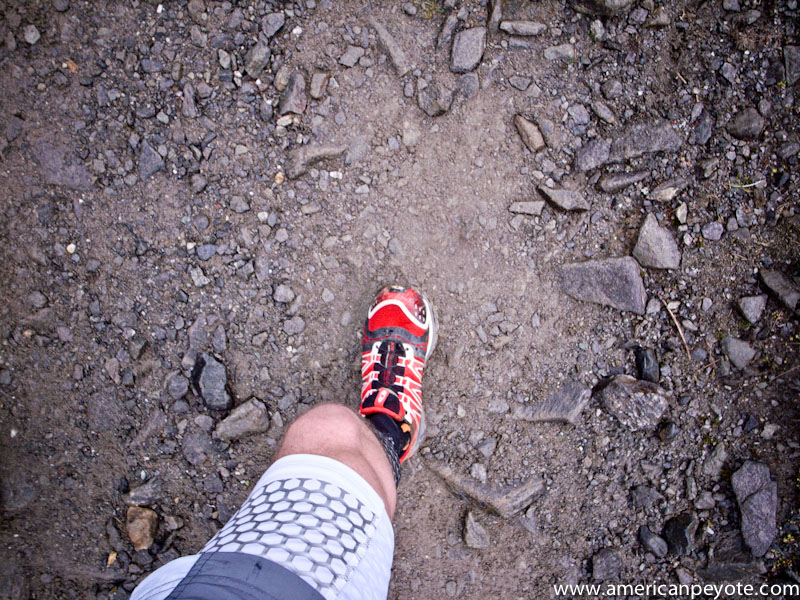
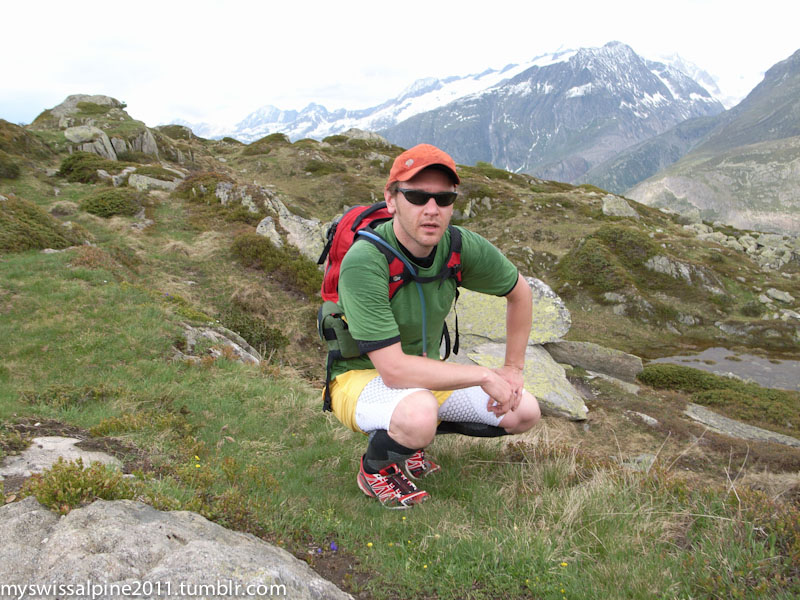
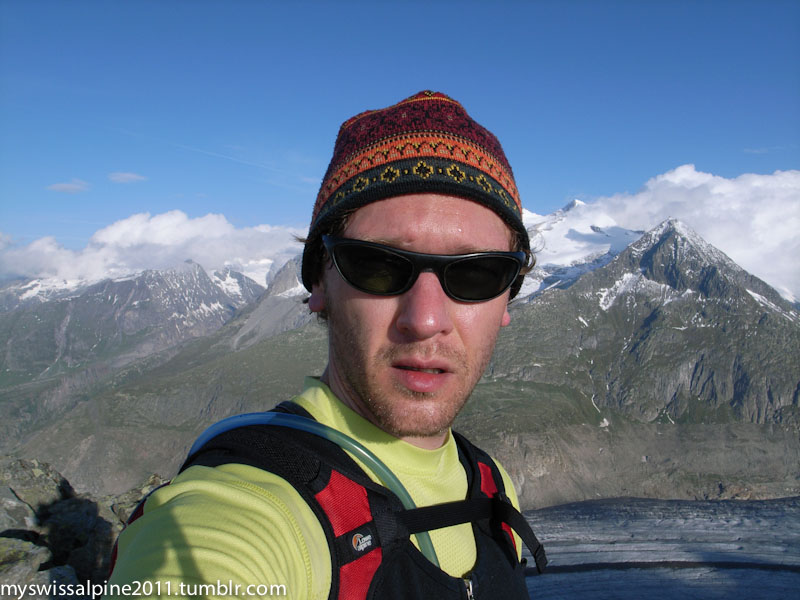
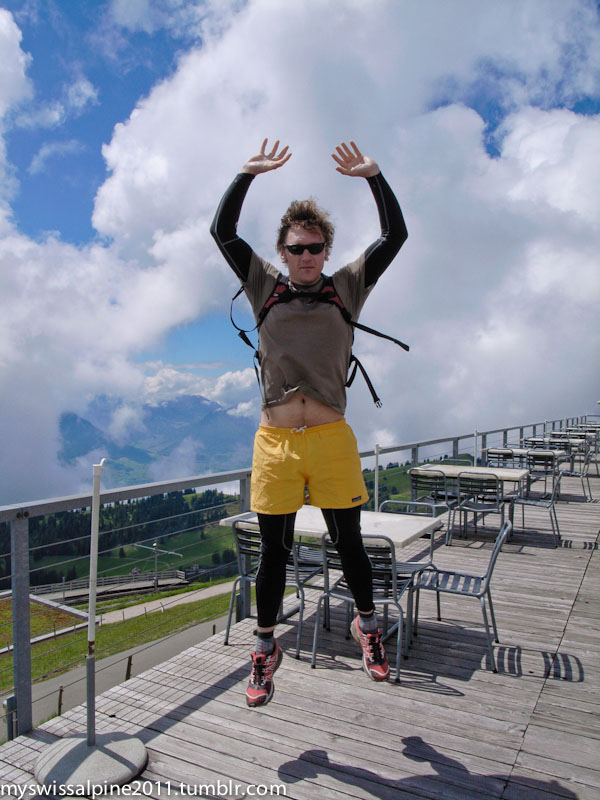
The goal of this weekend was to get into a little bit of shape, train my lungs at altitude and see what gear I need for mountain running. I had with me a pair of Salomon Lab running shorts, funky compression style running shorts that compress and stabilize your leg muscles while going up and down and around mountains. The support of the shorts is supposed to protect your legs so they don’t fatigue as much, and they also breath extremely well while keeping you warm in the alpine air. There’s also a very tight fitting shirt to wear, which helps maintain proper posture while running. I took along some compression ski socks to keep my lower legs warm. On top of that I wore my icebreaker wool shirt, which helped to retain heat in the cool alpine air. When paired with a pair of Pearl Izumi arm warmers, it all makes for a very energy efficient running uniform. It also makes you feel and sort of look like a member of the X-men. My girlfriend said I couldn’t run in just the shorts as their almost see-through, so I added a pair of Patagonia swim trunks.

Marathon Training

There are many things I’ve never done in life, including running a marathon and running at altitude. I normally keep a comfortably quick pace in mountaineering boots. So, for the first two days I spent my time running up from the dorf to the ridge which leads up to the Bettmerhorn.  Once you ascend up the hiking trail it’s more or less flat, and you can run between Riederalp and the mountain trail leading up to the Eggishorn. The panorama is beautiful from there, even if clouds come in from the distance and threaten to open up on you, it keeps you moving at least. Each day I had a small pack filled with a 2-liter hydration system, plus cold weather essentials and near useless things like my iPod. This is like 5 or so kilograms I probably don’t need to be running with during the SwissAlpine marathon, but I find it essential for training in a place where the weather can turn nasty before you have a change to find cover. I think once I get rid of the extra gear I’ll have some confidence that I’ll actually be able to finish the K42 race, but I also have 1.5 months to get my body in shape.

Last Ascent

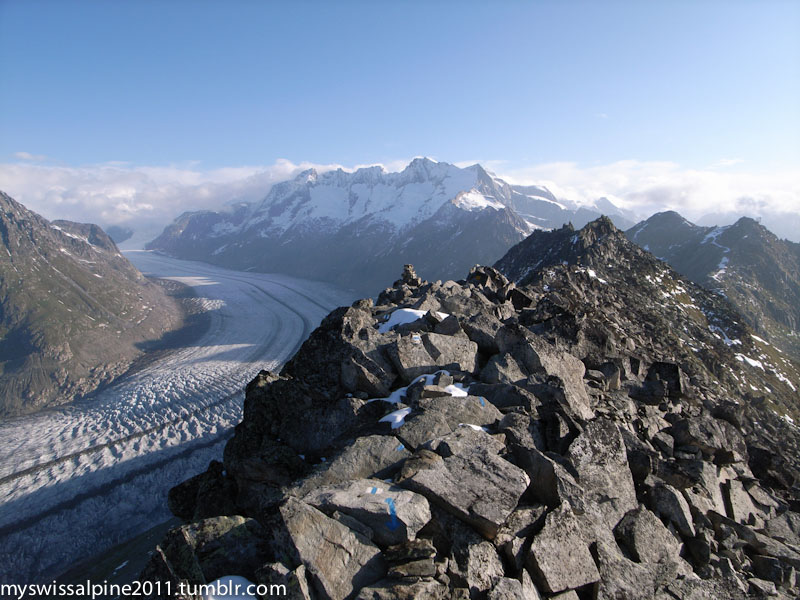
On the final morning I got up early and left the apartment around 5:30am in my mountaineering gear and hiked up to the ridge of the Eggishorn. Running in the hills is fun, but there’s nothing like balancing on a real rock ridge with a Swiss panorama all around you. I developed blister almost immediately. The Salomon running shoes are amazing on my heels, but my La Sportiva Trango are brutal. However, the Trangos let me balance on my toes on a thin rock edge, and the Salomon shoes just aren’t designed for an alpine ascent. I got up to the ridge around 7:40am, which means I maintained a pace of like 500m/hr ascending. I wanted to traverse the ridge to the Eggishorn but some dark clouds were moving in and it was pretty obvious I would be hit with some serious rain if I stayed up there too long. This is fine if you’re just running in the woods, but on a Swiss mountain ridge it’s just a stupid risk, plus I wanted to get down for breakfast.

Scaramanga Large Flight Bag Concept Images

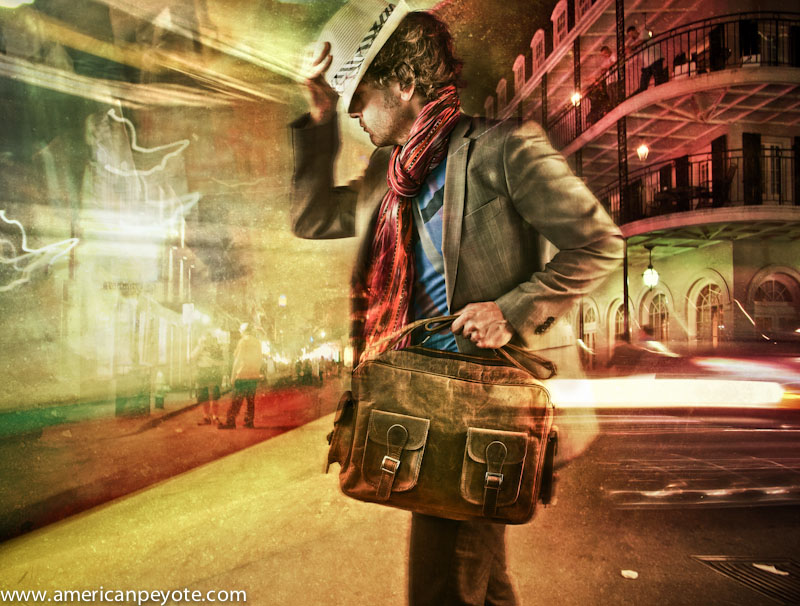
I don’t know how I found out about Scaramanga, but they’re just, basically my favorite vintage bag company in the world. Based in London they ship vintage bags, journals, cases, and other things around the world. They sent me this large version of the vintage Flight bag and I put together an image concept. I wanted to do something dynamic, something that combines the motion of the world with the bag concept. I had all the background images already in my head, I just needed to find and arrange them all together. I shot stills in my studio and then did some compositing in Photoshop to blend everything to my liking. You could say, this is how I imagine I feel like when I’m strolling through the street with the flight bag, naturally, my reality is a bit less dramatic. Enjoy. If you’re looking for a cool vintage leather bag or chest, check out Scaramanga Bags.

Bright Idea: Run the K42 SwissAlpine Marathon

I think it’s a good think to keep your mind flexible and challenge yourself in the, seep out of your comfort zone and do something excessive. So when my girlfriend suggested I run the SwissAlpine mountain marathon I sort of said “yes” in my heads. The farthest I’ve run so far is 10K at the Detroit Turkey Trot, and that was years and years ago. This is a bit more challenging, but the people in the Swiss Startup community are inspiring, and if they can start cool companies, I figure I can run the K42 SwissAlpine mountain marathon in Davos, Switzerland on July 30th. It’s 1800m of elevation gain, which is more than I normally do in a day of mountaineering, but I won’t be wearing a pack full of climbing gear. Besides, I’m an American and don’t sweat all those little details, I have a mountain heart and fierce, fierce determination, full of undeserved confidence, and anyways, I’m a Doktor of Science and I have a training plan. Now for some full disclosure, I don’t really like running all that much. At least, not on flat pavement, but when you’re running up a mountain you’re connected to the environment, part of the landscape. That’s why I’m doing it, I love moving through the altitude, and thinking that your body and spirit and flowing in the wind. Plus, the running gear that Salomon is offering is hands-down awesome.

Gear Matters

I know you should’t do sports because of the gear, but I don’t mind admitting that I’m running the SwissAlpine partially because I get to dress up like a superhero. It makes sense, I openly admit being a gear whore. The Salomon trail running shoes I have are amazing. I had a blister from running in my Scarpa approach climbing shoes, and the Salomon shoes don’t even put pressure on the blister area, it’s just amazing. The XT 5 SLAB running pack I’m looking at and their muscle support clothing also looks awesome, I can’t wait to run in the Wallis with the EXO shorts. It’s the perfect form of functional fashion, clothing which looks cool and actually improves your athletic performance. You’ll never find that mix at Dolce & Gabbana or H&M. My official drink for the event and training period is Isostar. I started drinking it years back when I was looking for a sports mix to help me hike/climb/ski faster and longer in the Alps, and Isostrar does the trick. I haven’t done an testing, I just know I go long and faster when drinking Isostar instead of just water. Gear is motivating, it feels nice to have a pair of Petzl arm warmers keeping you dry and warm when the weather turns dark and thunder rolls from Thor’s hammer across the sky, threatening to zap you with a lighting bolt if you run too slow over the mountain top. However, you have to back it up with results. If I’ve learned anything from the Swiss Startup community, it’s that ideas are useless with determined execution.

Training for the SwissAlpine

How do you train for a mountain marathon? I’ve asked the marathon runners and tri-athletes that I know, but it seems like this isn’t a normal type of race. Being a Doktor of Science, I decided to design a program-philosophy on my own. A lot of sources say things about running long distances and ramping up and ramping down, but that does nothing to address the altitude issue. So, instead, I’m training for the K42 like I would for speed climbing. I go to mountains in Switzerland, and try to ascend them as quickly as possible. For example, I ran/walked up Rigi Kulm from Goldau in 1 hour 50 minutes last Saturday, that’s a pace of about 500m/hour and matches my basic goal for the K42. It means I should be able to finish the K42 in 5-7 hours, which is 1800m up and 1600m down. It’s not for sure I can do it, I’ve never run a marathon before, I just like the mountains of Switzerland. However, I see no point in not being positive. That’s what Americans excel at, backing up an undeserved excess of self-confidence with measured results. In this case, I think a mountain madness training philosophy makes sense. Later this week I’m heading to Bettmeralp to train around the Great Aletsch Glacier. That’s why I’ll attempt a day trip in Bettmeralp, going from the dorf to the Oberaletsch SAC mountain hut and back. It’s an excessive amount of up and down and I’ll be leaving early in the day and coming back late at night. I figure if I just become one with the mountains and altitude and concentrate on being light and fast, I’ll survive. I’ll stay committed to this cause as long as it stays fun. What’s the point if you’re not having fun in life doing what you’re doing? I’ll add the big posts on my blog, but I’ve also started a new Tumblr with all the images and randomness of training for the SwissAlpine, http://myswissalpine2011.tumblr.com/.
God Envy – Deconstructing A Painting

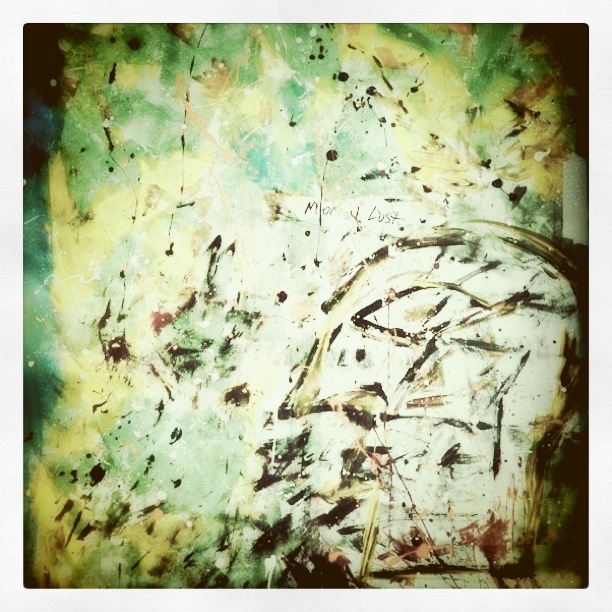
The most interesting part of writing an artist statement is taking the time to deconstruct your and explain to yourself what it is you’re doing as an artist. If you don’t do this I can’t imagine how you can write a coherent artist statement that anyone else besides the person in your head will ever understand. Going through my paintings it’s clear I’m interested in exploring the concept of God, mortals, and how they relate to one another. A lot of this comes from watching movies like Troy, 300, Clash of the Titans, Fight Club, and reading books like Jitterbug Perfume (Pan Aroma) by Tim Robbins. I especially like philosophizing on this line from Troy,

“The Gods envy us. They envy us because we’re mortal, because any moment might be our last. Everything is more beautiful because we’re doomed. You will never be lovelier than you are now. We will never be here again.” (Troy: Achilles)
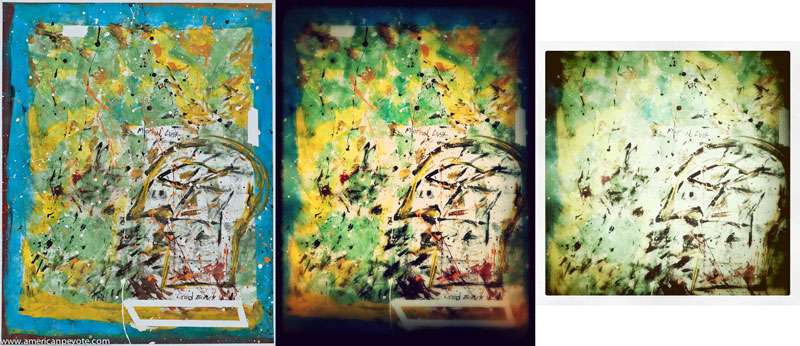
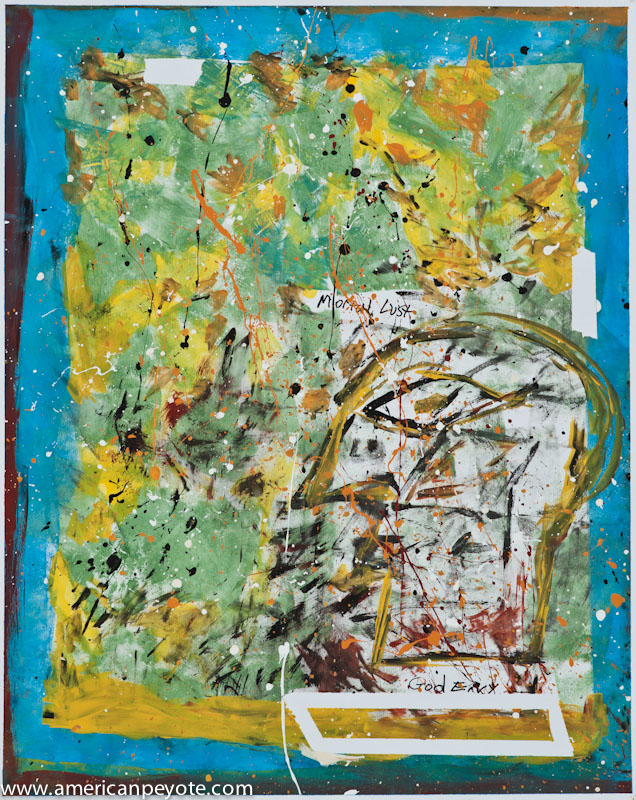
Often in my paintings I take this idea of gods envying mortals and mortals loving gods and combine it with the figurative representation of self-identity. It is the self-portrait, the question in the mind of a person in life, wondering what will happen when they die and if the gods will care when they are prayed to. This painting here I call God Envy. Above the head I’ve also written Mortal Lust. Of course, I wasn’t consciously thinking any of this, I just wanted to create something before heading to 1 Day of Art Copenhagen, and this is what I put together. Today, May 21st 2011 has been billed as the day of Rapture by a number of people around the world. It’s the day that the true believers (true believers of May 21st) will be raptured and the rest of humanity will be destroyed in the Armageddon, or at least it should start around that time.